Category: books

  • June 2025 Irregular Update

    June 2025 Irregular Update

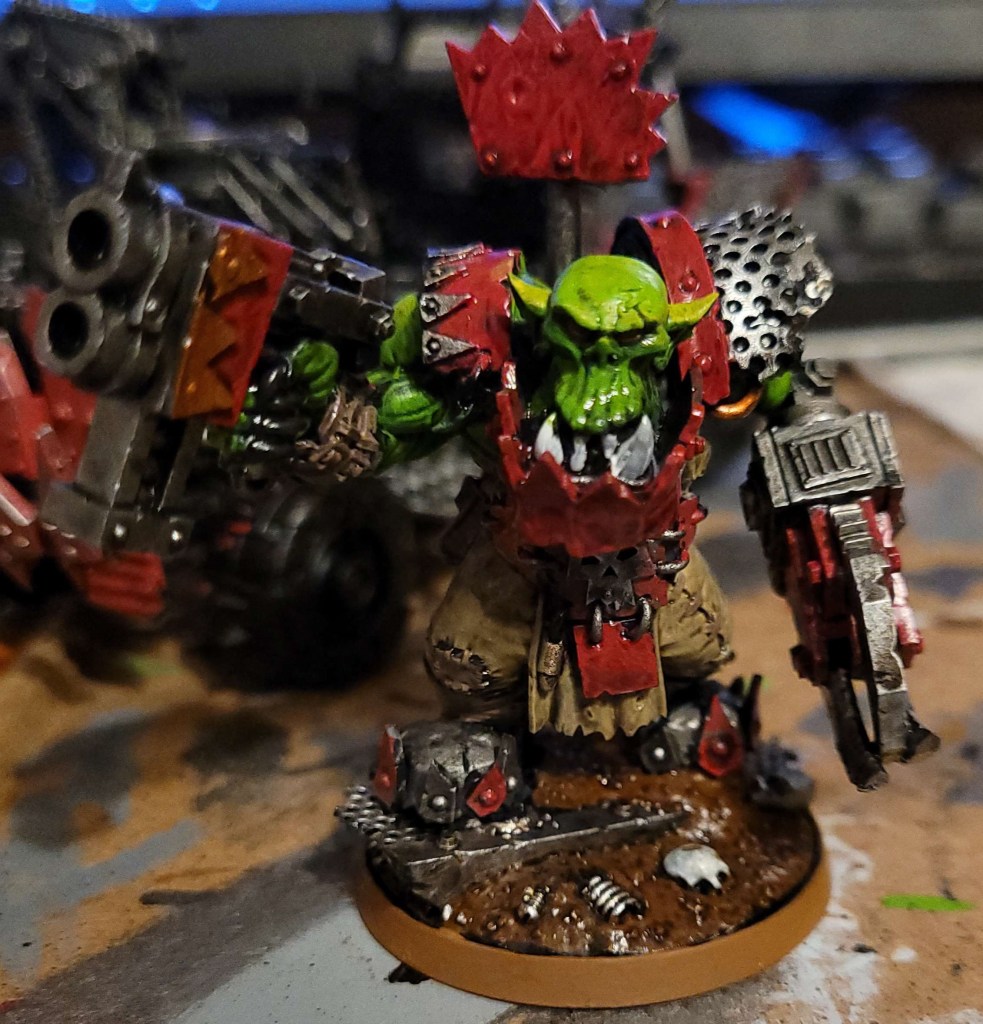
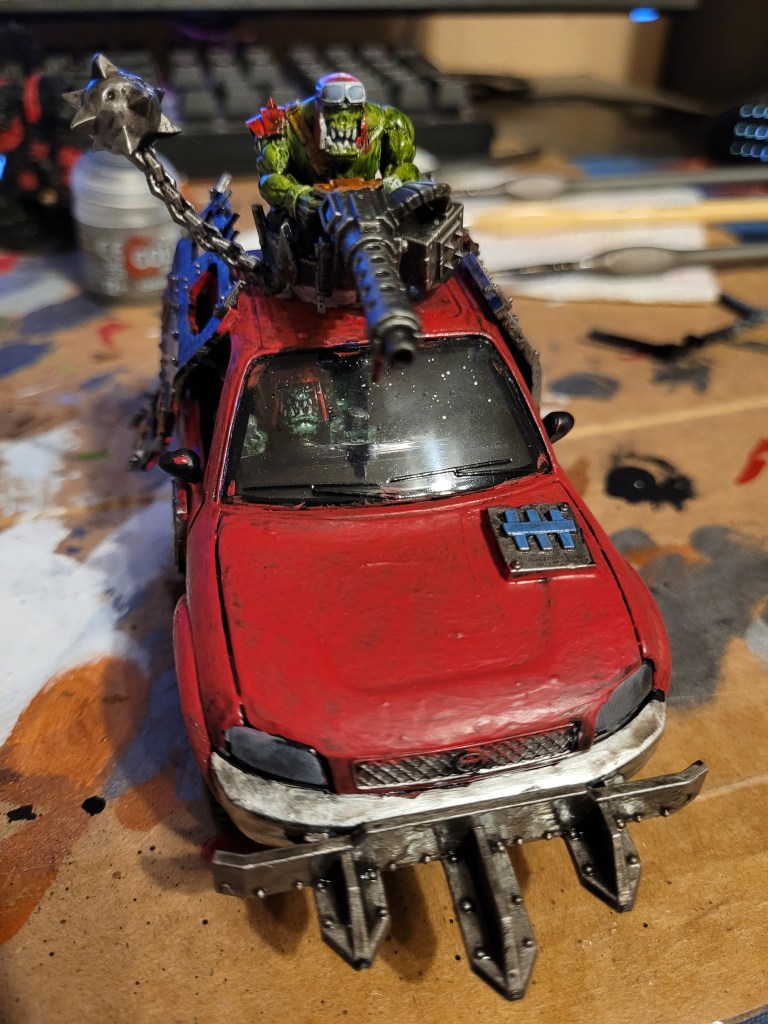
    So, here we are again. Look, I won’t beat around the bush. It’s been a tough year, hasn’t it? With everything going on in the world, (especially right now) it’s been hard to get into a space for writing. There’s been a lot of times this year that the only thing that could still my mind at all was this hobby I returned to in December (more on that later).

    I’d love to be showing up with great news about a project, but the truth is I don’t have anything to report on. As mentioned before, the Tide rewrite totally stalled out, and I almost got started on something else before getting entirely derailed. And not by video games this time.

    So. Let’s dig in.


    Returning Hobby?

    When I was in my teens, just after I’d been working for a while and had this sudden surplus of disposable income, my friends and I got into the nerdiest hobby on the planet: Warhammer 40k. We assembled and painted overpriced plastic miniatures and played pretend-war on the tabletop and had a blast. Some of my fondest memories are of those days – of visiting a local game store and playing all day, getting everyone some food at McDonald’s or Cici’s Pizza for cheap.

    And, my first models for Warhammer 40k were a gift from my grandma. When we started, our friend had gotten the Assault on Black Reach starter set, and two people locked in with the Space Marines and Orks. The original owner of that set settled into Eldar, and I started with the T’au Empire. We played games (not to exact specification of the rules – we never ran objectives and had little in the way of terrain), painted, and enjoyed talking about the game and lore.

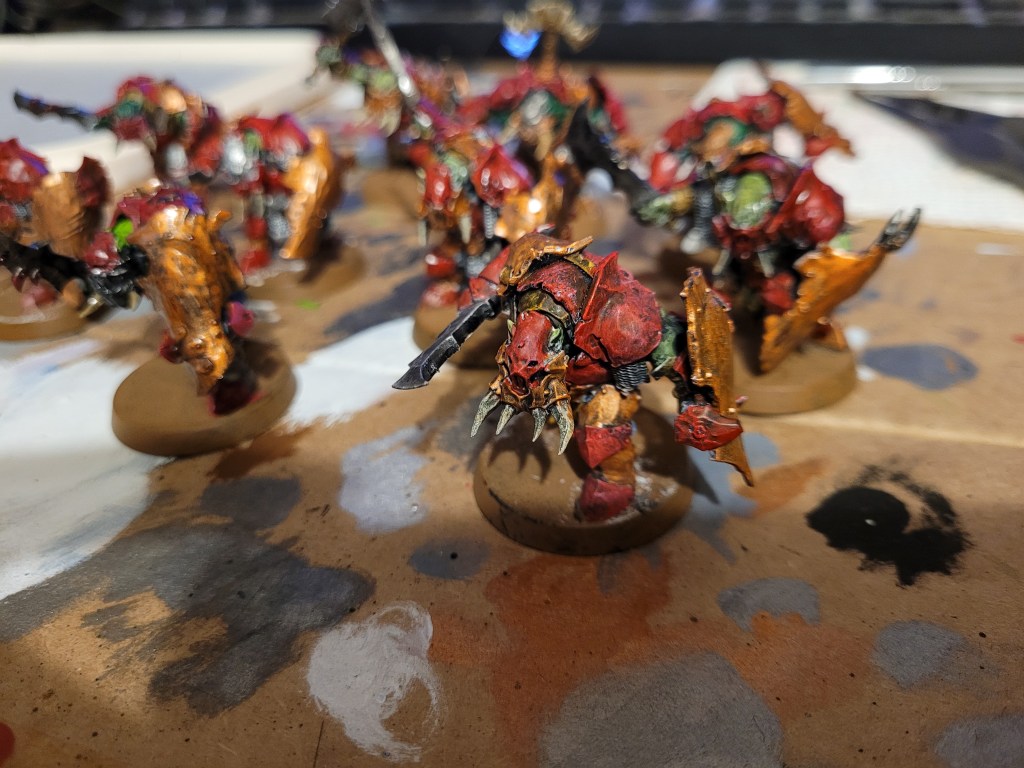
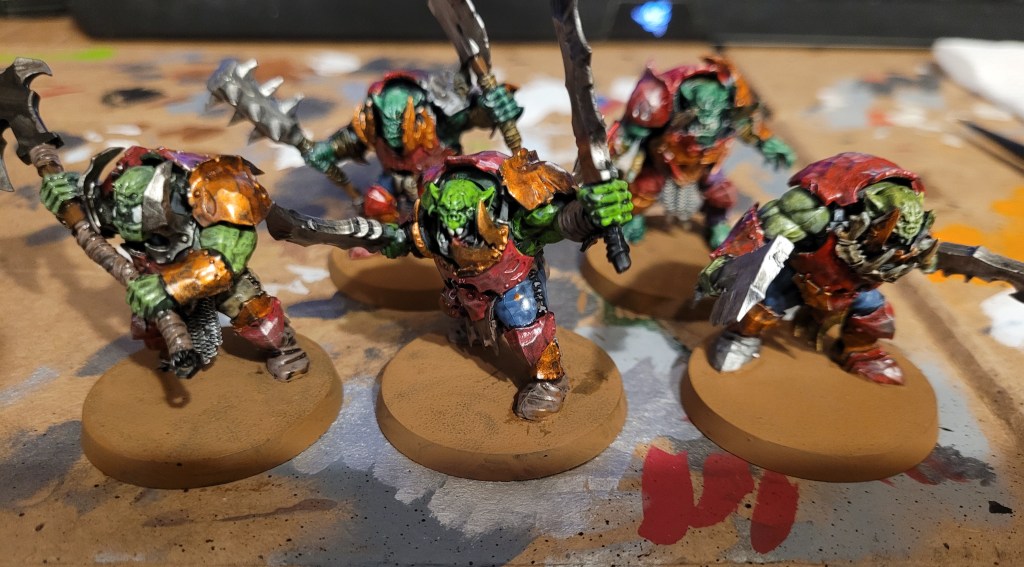
    I probably hadn’t painted any models in 8 years by the time December rolled around. But, after playing some Space Marine 2 with my friends and peeking at the minis, I finally caved at bought back in, starting with the Orks – the army I’d been leaning toward switching into near the end of our original time in the hobby.

    See, as teens, we all painted our share of orks. Our friend had more bodies than he could paint himself, and we were all happy for the practice. I got pretty good at painting orks, and, honestly? I think I’ve retained that skill.

    It’s been a much needed piece of serenity these last few months, and with the friends I’ve made in my guild on Warcraft, we’ve got our own little meta forming; one guy’s playing Death Guard and Custodes, another’s on Dark Angels and he’s brought in a friend playing Votann and Chaos Knights; we’ve got players on Tyranids, Imperial Guard, and Necrons. I’ve gotten a fair few games under my belt, and I’m looking forward to trying to find some time to play in person at a local store again. (We’re all across the continent, so we’ve been playing on Tabletop Sim.)

    So, that’s been my main focus the last little while. It hasn’t entirely stamped out writing, of course. I’m still running a D&D game weekly, and I’ve been running a once-to-twice a month game for my family. And, I’ve written little bits of lore about my army of Orks and the characters therein, written up some small narrative moments from some of the battles we’ve had.

    I mean to say I’m still exercising the muscle, even if I don’t have a book to report any progress on.


    … But You Will Write Another Book, Right?

    Yes. Yes, absolutely.

    Look, there’s been times when this has been disheartening. There’s been times when I’ve questioned whether it was worthwhile to keep paying the upkeep on the site and blog – especially since I have these long stretches where I do nothing with it. But, ultimately, writing means a lot to me. I’d be lying if I said I didn’t care if no one read me – I want my stories to mean something to people.

    For that to happen, though, I have to write the damn things.

    So. I’d better do it then, huh?


    How’s About the Blog, then?

    Oh, yeah. So, you might’ve noticed the new digs. I’ve changed hosting services, and, after all the work I put in over the last week to set this all up, I’m going to hit myself if I keep letting this slip through my fingers.

    I get into my head about it, is the problem. I often feel like I have little to add or nothing of note to say. But this is my corner of the internet. If someone doesn’t want to hear what I have to say, they can good and damn well leave, can’t they?

    And if you’re one of the ones sticking around, thanks. Thank you for reading.

    I’ll see you again in the next one.

  • December 2024 Irregular Update

    December 2024 Irregular Update

    Hi.

    Yes. I know. It’s been much, much longer than I intended since the last one of these. Since the last blog post in general. I … did not mean for it to go this way. Hell, I think the only thing that’s putting a fire beneath my ass to do this now is that I have my 2024 Year in Review post ready to go and it feels like I should probably address some stuff before I do that.

    So. What the hell happened, huh? Maybe we can both figure it out after prattling on for a while.


    Where were the blog posts?

    Well, at the top of the year, I had some turmoil with D&D. Well, more correctly, holdover turmoil from our experiment with Pathfinder. The homebrew game I was running petered out. We had one player who wasn’t all that jazzed about going back to D&D and another who was losing availability for a couple of months. So, we wrapped up the dungeon we were in and called the game.

    Not something I’m unfamiliar with – I’ve been running D&D for nearly fifteen damn years at this point. I’ve had more games get canned than reach their intended conclusion. Still, this one stung. This game was practically full-on sandbox and I wanted to more or less run the game as a gift for the table, let them explore and self-direct to the extreme. I was happy to put in the extraordinary time I might need to week-to-week to set the track down right in front of the train, but it still didn’t work out. And perhaps the complete lack of direction wasn’t the right fit for the table or the characters they made, maybe it was entirely down to the external obstacles, but it stung to lose that campaign.

    After that, I ran Blades in the Dark for about three months or so with the two players who stuck around. That system was some good fun, and we enjoyed it well. It’s built incredibly well for allowing the players to have the initiative in their choices and actions – it’s the exact inverse of D&D. In the latter, the DM has a situation they present to the players and the players respond; in Blades, the players lay out a heist (called Scores) and the GM reacts to their actions. Perhaps a bit of an oversimplification, but it runs well and we had some good fun!

    Once we got to the end of our “first season” of that game, we got one of our players back and were joined by two others and we went back to D&D. I’ve been running Tyranny of Dragons since June and it’s been going well. It’s my second time using the module and I’ve made some major edits to its structure – ones I’d love to share here on the blog, but half of my table has a habit of reading this blog, so that’ll have to wait – at least until we’ve passed the moments that have been adjusted.

    (I know, I know. How can someone have a habit of reading this blog when it’s been silent basically all year. Hush.)

    Another major source for much of my RPG related-posts was playing in a friend’s game who was running the game for the first time. I had the boon of seeing someone with no experience running the game and it reminded me of many of the lessons I’ve learned over the years – and he managed to do some inspired things despite his inexperience that I wanted to praise. Unfortunately, that table also dissolved due to out-of-game circumstances (luckily after the module’s completion).

    I’ve since had the privilege of joining another game that’s run once a month run by another friend, but I had this block, this wall up, that held me off from drafting anything.

    I had some other topic ideas at the start of the year, which made me feel fired up enough back in the January Irregular update, but … well. I lost confidence in claiming that I had any worthwhile experience to actually write those posts.

    These ideas were about the steps I took for independent publishing. Problem is, it’d be delusional to say I’ve done this successfully – at least, to the degree that I feel like my experience would be valuable to someone desperately googling for advice. Regardless of the validity of that worry – it held me off from drafting those posts. So. There it is.


    And … Red Watch?

    In January, I was feeling good about my decision to rewrite the first two books, and I still think pulling them down was the right decision for me. By February, I had completed the draft of A Violent Peace, and sent it out to several folks, people who’ve previously read for me. To my knowledge, none of them ever got around to it, or got very far into it. And I do not begrudge or blame or have any negative feelings toward them; beta reading is a lot of work for no compensation – any time it’s done, it’s a favor, and I’m thankful for them all offering to begin with.

    The point is, the complete lack of engagement was disheartening. The book probably still has many problems. I think there’s some stuff within it that works well, but there’s likely far more that just isn’t working.

    I spent the next two months diving headfirst into the rewrite of A Tide of Bones. I made some excellent headway and I was really liking some of the changes I made. … But there were many more things that were proving exceptionally difficult. I had adjusted the characters a little to provide a new central tension in the first quest of the book, but those changes were … I don’t know if they were right. And I just kept struggling with more and more things; with proper POV division, with some repetitive motivations following the events in Souhal. There’s obviously too many characters, too, but I don’t know what to do about that.

    I mean, clearly the solution would be to cut characters. But to do that would be to surrender the goal I had of not completely changing the canon of the stories so returning readers could pick up A Violent Peace. And would require major rewrites to A Violent Peace, given that it was written with the previous canon to begin with.

    So … do I scupper the whole thing? This project is like a hydra – every problem I address spawns more. How much more do I want to wrestle with it? How much does it get mangled before it’s unrecognizable? Am I going to tie myself to this anchor and just keep on with it? Or do I cut it loose?

    I think … it’s probably the latter, isn’t it? It’s been eight months since I’ve written a word that wasn’t for D&D because of this weight around my neck. I even flubbed the journaling.

    “Sometimes, taking a leap forward means leaving a few things behind.”

    Maybe it’s time to do just that, Ekko.


    So … what’s next?

    If I’ve learned anything, it’s that making promises or exclamations in a random blog post aren’t worth a damn from me. Lately, I’ve been failing to find things to do – to find distractions that will keep me busy and off-track. For a long time this year, I was playing too much Warcraft, too much Baldur’s Gate and Deep Rock Galactic, over-prepping for D&D, all sorts of stuff. But, the sheen’s wearing off.

    When I’m not doing anything else, I end up writing.

    So. Let’s see what we end up working on, then.

  • Third Time’s the Charm

    Third Time’s the Charm

    I’m not a particularly spiritual person, but I can see the appeal of something like numerology. You can do a lot with numbers to fit them into a narrative. They’re malleable and also observable.

    Growing up playing Super Mario 64 and Zelda games, three’s always been a bit weighted in its appearances. Throw Bowser three times; collect three spiritual stones to unlock the Temple of Time; you’ve got three days before the moon crashes into Hyrule–good luck, kid.

    We like making three significant. We like to see Threes. Trilogies, acts, whatever.

    But this post isn’t about magic numbers or video games.

    Instead, it’s about my books.


    The Third Book

    That heading’s a bit ambiguous, isn’t it? I released Ebonskar as my third book, sure, but I was working on the third Red Watch book first. I finished Ebonskar before completing a draft of A Violent Peace, but the latter is the third book in its series. That’s the numerology coming back around.

    And, truth is, those two are only two-thirds of what I had in mind when writing that header.

    Let me explain.

    So, Ebonskar. That book really grabbed me when it did. There was no way for me to get around it. It was all I was thinking about at the time – my head didn’t have space enough for it and Red Watch 3 to linger in there. I had to get it out first.

    And I’m really proud of it. I’m not just being a salesman when I tell people I think it’s my best work yet. It’s a good book – it’s not perfect, but the people who’ve liked it loved it. (So far as I’ve heard, anyway.) With Ebonskar, I felt like I crossed a new threshold in my ability as a writer. I can see the difference in its quality and that of my earlier works.

    Which, has caused some turmoil. Namely, that I don’t feel right selling my first two books anymore.

    Flipping through the pages of A Tide of Bones or Legacy is more liable to make me cringe than not. There’s some good ideas and such in there, yes, but my inexperience really bogs them down and makes what good there is hard to appreciate, even as the author of the work. Truth is, I fumbled.

    It was a lot of work to write a book. I didn’t want it to be for nothing; I didn’t want it to be a fantasy. I’d wanted to write my whole life, and I had, so, why not sell it? Right? I got goaded and I goaded myself into releasing it.

    If I could go back, I’d tell myself to wait. I’d tell myself to keep writing and learning, and to come back to Tide someday. Which brings us to today.


    A Really Dumb and Necessary Plan

    I’m proud of A Violent Peace. I think the third Red Watch book has some good bones, and I’m excited to hear back from my beta readers. Problem is, I don’t know how I can sell it if I don’t feel right selling the two preceding books. I have to find some way to be happy with them again to sell the series at all.

    Good news, though: I’m this whole business. I can do something dumb, something semi-self-indulgent, something necessary for me and I’m only affecting myself.

    So, effective immediately, A Tide of Bones and Legacy are no longer available for sale. They’re off the market.

    Until I finish rewriting them.

    My plan is to redraft A Tide of Bones and its sequel and release them again this year. If all goes as I hope, there will only be a few months between each book, and A Violent Peace will still be available toward the end of the year.

    This is the announcement.

    Strap in, readers. It’s going to be one hell of a year.

  • January 2024 Irregular Update

    January 2024 Irregular Update

    Happy New Year, everyone! Been a while since the last one of these, so here we are again. Read on for updates on Red Watch 3, the blog, and more!


    Did you finish the draft of Red Watch 3?

    No. Not yet. I hit a bit of a wall that seemed bigger than it was. Coming into the new year, I picked up a new habit (more on that later) that helped me work through it. I’m making steady progress again, working on the penultimate or final chapters of each storyline in the book to be followed up by the epilogues. It’s the biggest ones left, but I’m optimistic about completing the draft by winter’s end.

    Still unsettled on a title. I have a short list of some ideas for one, but I haven’t been enamored with any of them yet. As a peek behind the curtain, the front-runners right now are A Violent Peace and A Merciless Union.

    One more thing for Red Watch: in the upcoming months I’ll share something big here on the blog. It’s something I’ve been considering for a long time and once the draft for book 3 is done, it’s my next project. You’ll know more about it in a few months.


    Latest on the Blog?

    So, middle of last year, I started missing dates for my goal of two posts per month. I still mostly got one out each month, but inconsistently. One month I’d drop one a few days in, the next one it was on the last week. A handful of factors played into that.

    The first: when I hit my wall on RW3, I ended up hardly writing anything. I was expecting I’d get disrupted by some of my hobbies in the back half of the last year (Baldur’s Gate 3), but I didn’t expect it to the degree to which it happened. And I’m not blaming BG3 – when it came out, it was all I was interested in spending my time on. That isn’t a fault in the game (probably a credit to it, really). It just coincided with a time when I also had few enticing ideas for blog posts.

    I had drafted a couple posts, even, but I wasn’t satisfied with them afterward. I had one cooking about Starfield – mostly outlining my disappointment and a growing frustration with customers who wanted to say that the jank was fine because Bethesda used to make good games. I had another about Warcraft, but I ended up disagreeing with my own thesis less than a week after drafting it. (It was written on the week 10.1 dropped, when we had the next zone available, but not the raid or mythic+ season. At the time, I was unenthused with the prospect of spending another patch pugging dungeons for all my progression, but my friends and I joined a guild and started having a lot more fun again. Playing an MMO with a community works, who would’ve guessed?)

    There’s a weird problem with the blog. I like to write on a topic when I feel like I have something to say about it, but oftentimes, it seems what I would say has been said already – in a reddit post, in a video essay, in an article. If I don’t feel like I’m adding to the conversation, I wonder what the point of the post even is. Sometimes it’s worthwhile – with the political posts, those are battles we keep having to fight.

    When it comes to Starfield? What’s one more nerd’s article about his disappointment good for? Do I really need to write a post about how weird it is that the fourth Indiana Jones movie got so much criticism when the movies all seem to be full of shlocky bullshit? Is that something I want to go to bat for?

    The final factor: I spent much of the year running a Pathfinder game. As I discussed in my blog post on the system, it’s really solidly built. (Awesome for some, didn’t work out for me.) One of D&D’s flaws is the holes in its system that I had to fill in over the years with homebrew solutions. The latter (while worse as far as a professionally designed product goes) (especially one released by one of the biggest companies in the world) provided more opportunities to find problems to solve, solutions to work out. Thoughts that might be worth sharing with others.

    Anyway. I’d like to get back to two posts per month. I just need to figure out what I want to write about – what kind of things you might want to read about. Hell, maybe you’ll see a post very much like those above-mentioned abandoned drafts.


    What else is going on?

    Earlier, I mentioned I picked up a new habit. At the suggestion of my younger brother and following the example of my older brother, I started journaling during the last week of December. (I believe all successful New Year’s Resolutions begin before the new year does.)

    I’ve journaled before – usually to vent or when I couldn’t sleep. Now, I’m doing it habitually. No matter how inane or uninteresting my day is, I write about it. (And I work from home, so my days can be really uninteresting.) I journal about my thoughts, my plans for the day, where I am with my writing. It’s helped; a lot. I’m fully bought in. I’ve got two more journals waiting in the wings.

    Otherwise, I’ve slammed through some books since Christmas. I read Murderbot #3-7 (Martha Wells) and the Sunlit Man (Brandon Sanderson) in these last three weeks. I’ve locked up one full, uninterrupted hour to read every day when I finish my shift at work.

    I’ve been looking at the Blades in the Dark TTRPG, and I’m planning to start running it with my table in a few weeks. Really excited about the system. It’s hard to like Hasbro / WOTC right now, so I kind of just don’t. Makes it even more enticing to give it a run.

    Think that’s about it! I’m taking the risk to say I’m pretty optimistic for this year. I think it’ll be a good one. As always, thank you for reading. Good luck this year, y’all.

  • May 2023 Irregular Update

    May 2023 Irregular Update

    Yikes, it’s been a while since I did one of these. I did promise irregularity, but 13 months … woof.

    Okay. Well, here’s where we are.


    Employed Again

    I guess the big news is that I have a job again right now. It’s a multi-month contract position that’s work-from-home, so I’ve got money coming in. (And not a second too soon, since my website hosting dues are coming up.) While this means I’ve got less time available, I’ve actually been writing more consistently. Financial instability was hell for my stress; maintaining the blog and prepping for my D&D game was about all I was good for.

    Hopefully it remains that way. My position potentially includes some mandatory overtime. I’m not at all fond of that idea, but we’ll have to wait and see what specifically might be expected of me. Everything should work out as long as it isn’t too disruptive.


    So, what’s the news on Red Watch 3?

    Well, first up, I hit my outline again and streamlined it some more. I cut another ancillary plotline from the book, but unlike last time, this one had involved some characters of Red Watch that I can use elsewhere now. I’m not upset about the loss here, either. It was a subplot that kept two people in Souhal, and removing it has also helped several other characters find space to behave more as I’d imagine them to.

    There was also several additional Point-of-View characters I’ve cut from the remaining plotlines. These were mostly from brand new characters that had little-to-nothing to do with Red Watch as a group. I had specific roles in mind for them when I’d created them, but they were bloating the story. Sometimes less is more and now I can condense these ideas down into the familiar characters we’d want to see more of anyway.


    What’s all that mean for the book?

    It’s still early days on my productivity here, but I’m feeling really good about it all right now. I’m sorry this one has been taking me so long, but the good news is that I can truly see and feel the ways I’ve improved as a writer since that first go at Red Watch 3.

    The goal at present is for this draft to be done no later than the end of the year, with the release of the book no later than next summer. The earlier I finish the draft, the sooner it will release. If I can start editing and obtaining beta reader feedback by fall, we’ll shoot for a release in spring.

    Oh! One other thing! Since my father paid for me to have a year of Inkarnate’s pro subscription, I set some time aside and remade my map of Amera!

    I’ll be adding this to the Red Watch page here on the website and my social media soon – but until then, you blog readers get the exclusive hook-up.

    As always, thank you for reading! Here’s to many more adventures to come.

  • Ebonskar and D&D – How Much Changed?

    Ebonskar and D&D – How Much Changed?

    Since its release last year, I’ve made it no secret that much of the story of Ebonskar was inspired by a D&D campaign I ran featuring the titular character as its primary villain. Obviously, a lot of changes occurred to craft a narrative fit for a novel, but many of the characters and facts of the world were kept whole in the adjustment. With today being the one year anniversary of Ebonskar’s launch, I thought it would be fun to invite you to take a closer look at some of the changes that were made.

    As a warning, this post will contain some spoilers for the novel, but I’ll do my best to avoid anything too significant.

    What characters in the novel originated in the campaign?

    Several of the characters I created as NPCs carried over into the novel. In the game, Kheta existed, but she had fled Rafdorek alone. And, she wasn’t responsible for the invention of firearms: she’d just been a garden variety smith who got fed up with the society and decided to leave. She ran the only forge in the town the campaign began in, and was the first clue about where the game was ultimately going to go. One of the first quests in the campaign was to track down and defeat a Hobgoblin Iron Shade that had come to the town specifically to kill Kheta.

    Captain Jameson had a different name (Captain Thomas), but his role as guard captain that’s been left in charge of the town because of a pause in greater politics remained. And Lieutenant Nicholas carried over, as did his heroic sacrifice when Ebonskar came to the town.

    However, beyond them, it’s almost entirely the hobgoblins that carried over (Redeye, Scalpseam, Charscowl, many others – all names I used in the campaign). Most of the other characters were entirely invented for the novel, or were so fundamentally changed that sharing a name isn’t enough for me to think of them as being the same.

    Did the Geren-thal change at all?

    All of the Geren-thal with the sole exception of Inquisitor Suthri existed in the campaign and were defeated by the party eventually. Suthri was created for the novel when I expanded Rafdorek’s history and society more than I had for the campaign. An inquisition made perfect sense for the oppressive regime and the original Eighth of the Geren-thal was simply a ranger-styled hobgoblin fighter.

    They were set up in a more gamified manner, however. Each one’s rank was an indicator for how powerful they were. Ebonskar was fourth, and the first the party encountered. In the battle, the party had two allies they’d gained that helped even the playing field. Ebonskar was built off of a 15th level fighter, and the players came up against him when they were around level 7 or 8.

    Did any of the player’s characters transition over?

    No – or at least, not in Ebonskar. Many of the characters wouldn’t work in the more restricted setting for the novel. In the party, we had a dragonborn paladin, a halfling barbarian, and my brothers were a drow gunslinger and a human ranger with a wolf companion. The setting as adjusted for the novel lacks both elves and halflings, so neither of those characters would transition over well. The deregal are more-or-less the dragonborn, so the paladin could work, but I also believe those characters belong to my friends who played them: even with their permission, I can’t say I’d want to write them myself.

    The only facet that carried over at all was that my brother’s drow had discovered the plans for firearms when his people had raided a dwarven settlement and decided to hide them from his people and escape to the surface. The dwarves had long ago made firearms and decided they were horribly dangerous and refused to trade them. The other nations of the world tried to force them to do so, and lost what was then remembered as the Thundering War.

    So, the deregal are basically dragonborn, the hobgoblins are practically one-to-one – did the Jerrath exist?

    They did not! I decided before I got into writing Ebonskar that I didn’t want it to be as sprawling as a D&D setting with a vast array of fantasy races. Orcs are among my favorites of the usual inclusions, and I didn’t want to lose the “these people are just all big and badass” flair with their absence. I started creating the Jerrath, and my first visualizations had them more similar to the Amani trolls from Warcraft than they ended up being. (I had this very well defined picture of Zephal in my imagination: massive, muscular, long curled tusks coming down from his upper lip, a vibrant mohawk. It’s really just the tusks that didn’t carry over.) I also generally like the “we have been here longer than everyone else and we live longer” trait of elven races and how that can add a different texture to a setting, so that got rolled into the Jerrath too. In the D&D campaign, the world was even still named Crucible, only in Elvish!

    Obviously the rules for magic are codified in a D&D game, how did the magic system in the novel evolve to where it ended up?

    The “vancian magic” of D&D wasn’t something I wanted to copy full cloth into the novel, so I knew I was going to be changing things up. When I was writing Ebonskar, I was playing through Dark Souls III for the fourth or fifth time and happened to be running a pyromancer build. I loved the divide in the game of pyromancy, sorcery, and miracle-based divine casting and the divisions of magic were inspired by that. I love magic in fantasy novels because it can create incredible moments, but without any sort of included drawback having a wizard around can make it difficult to keep tension. Having magic turn into something of a faucet that the spell casters have to very carefully use or risk drowning themselves into nonexistence felt like a good stopgap to allow for some impressive feats that couldn’t solve every single issue the characters came across.

    How did Tanda exist in the campaign?

    As a different, much more centrally located town called Borno’s Crossing. It began as a bridge over a river along a major trade route before a Trader’s Highway went up and it fell off with reduced foot traffic. The premiere establishment was Brandywood’s, a tavern opened by Borno Brandywood when he founded the town about three hundred years before the campaign. When the party arrived, it was operated by his great-great-niece. A lot of the opening quests did lay hints regarding the hobgoblin threat, but the party didn’t track them down, and their big hurrah before Ebonskar arrived was defeated a hag that had been terrorizing the town for half a decade. Much like Tanda, it did suffer Ebonskar’s presence first in Vromali, and running the game that evening was really something.


    As a bonus, I’ve used dndbeyond to create a more presentable stat block for Ebonskar (my old notes were a mess) and had some artwork done up! If you’ve got any interested in using Ebonskar against your players, here’s the stats I made to run him as an enemy against my own party.

    As always, thank you for reading! I hope you enjoyed this little retrospective.

  • The Witcher: The Lesser Evil

    The Witcher: The Lesser Evil

    Sapkowski’s The Last Wish is a favorite of mine. I don’t often reread books, but after the second season of The Witcher on Netflix released, I revisited this one. One of my favorite short stories in the collection is The Lesser Evil, and I doubt it’s a coincidence that it’s what Netflix chose to adapt for their first episode of the series.

    If you’re unfamiliar with it, I genuinely recommend picking up The Last Wish and giving it a read, or at least watching that episode of the show.

    I want to talk about something from that story that I’ve seen be … misunderstood by a few people. Something that’s taken out of context and bandied like it means exactly what it says. Major spoilers for The Lesser Evil below.

    The Context

    In the short story, Geralt arrives in Blaviken and reunites with an old acquaintance who invites him to stay in his home. On his way into town, Geralt came across a monster and slayed it. He hoped there might be a contract for it in the town, but there isn’t. He’s about to throw it’s carcass out, when some of the townspeople mention that a wizard in town might have a use for the thing. Geralt decides to try his luck.

    The wizard doesn’t want it. But he does want to hire Geralt for another monster that’s been chasing him. He talks about a Curse of the Black Sun, that women born during an eclipse are mutated, cursed, or possessed by demons. The wizard had encountered such a one, and tried to have the girl executed, but she escaped. He asks Geralt to kill her before she can try to hunt for him here, in Blaviken, and by her presence, lock him in his tower. Geralt doesn’t kill people for money, only monsters, and Stregobor pleads that he needs to compromise, as the wizards of old did when the curse first came around, and choose the lesser evil.

    “Evil is evil, Stregobor,” said the witcher seriously as he got up. “Lesser, greater, middling, it’s all the same. Proportions are negotiated, boundaries blurred. I’m not a pious hermit. I haven’t done only good in my life. But if I’m to choose between one evil and another, then I prefer not to choose at all.”

    Renfri, the girl allegedly cursed by the eclipse, speaks with him later. The legend behind the curse ruined her life, she was a princess, but Stregobor telling her family of the curse got her thrown out of the castle. She’s fought to survive, killed to avoid being killed, stolen to satiate starvation. She asks Geralt to kill Stregobor, as a lesser evil, and Geralt refuses again, saying he doesn’t believe in a lesser evil.

    “You don’t believe in it, you say. Well you’re right, in a way. Only Evil and Greater Evil exist and beyond them, in the shadows, lurks True Evil. … And sometimes, True Evil seizes you by the throat and demands that you choose between it and another, slightly lesser, Evil.”

    So Renfri employs the Tridam Ultimatum. Her and her crew are going to kill people at the market until the wizard vacates his tower. Geralt, panicked, rushes to the market before it opens to stop them. It ends in slaughter, Geralt forced to kill Renfri and her crew. Stregobor would have let them eradicate the whole town before he left his tower, and Renfri would not leave until she at last had her revenge.

    The Evil of Inaction

    Geralt, in his obstinance, didn’t act. Despite his sympathy for Renfri. Despite his existing disdain for Stregobor. It sticks with him forever. By not acting, he allowed a greater evil. By choosing to refrain, he chose a greater evil.

    It’s crazy how often I’ve seen the quote thrown around without irony. The story very clearly shows how that philosophy just doesn’t work. Refusing to choose doesn’t mean you are absolved – after all, you haven’t refused to choose, you’ve just chosen to do nothing.

    We can’t always see what all the consequences of our actions might be. We can only try and make our decisions with empathy and love in mind. Strive always toward good. Even if it means the most you can do is choose the lesser of two evils.

  • April 2022 Irregular Update

    April 2022 Irregular Update

    It’s been about seven months since my last update post. I do believe these posts will continue to pop up irregularly, but getting at least two major updates out in a year seems like a fair minimum to reach for. So, here’s how it’s been going.

    Where are you on Red Watch 3?

    Some mixed news here. Shortly after revisiting the project, reading through what I’ve written and my outline, I ended up making some major revisions. I caught on to some glaring pacing issues, restructured how I was planning to present the chapters, and ended up with an entire storyline that proved to be too much for the book. I hope not to leave that hook hanging, though. When I’m getting my completed draft into the hands of beta readers, I might work on that plotline as a companion novella – something similar in scale to Thuna, but it likely won’t be included in the book for Red Watch 3 as a collection. I’m still adjusting some stuff, finding out what I need to rewrite in the new draft, and more challenges could end up coming down the pipeline, but I’m making progress.

    It’s undoubtedly the most ambitious thing on my plate. I’m needing to be more considerate of how to keep the plates spinning with all that I set up in the first two Red Watch books and bringing everything forward in a satisfying way. I’m hoping to get a draft in the hands of my beta readers this year. I’m sorry that the wait for this book is proving so long, but I haven’t surrendered. Thank you for your patience, everyone.

    How’s the blog going?

    I’m enjoying it more than I thought I would. Being upfront about just writing about anything I wanted helped me open myself up to it, for sure. I’ve always been a quiet person socially, just felt like I didn’t have much of value to add to most conversations. But, building my own little soapbox on my website worked, since anyone who doesn’t want to hear from me can just … not be here? Easy enough.

    When I was starting the blog, though, my hosting service had a system for comments to be left on each entry and I was sad to see that disappear. I’m interested in some entries serving as a conversation starter, but I’m not trying to cross-post every entry here on every social media site. I never cared for them much – getting me to log onto my Facebook is like pulling teeth, and I use it specifically for book promotion.

    All to say that it’s good. I’m like the pace of getting out two entries a month, and I think I’ll at a minimum manage at least one. I will say most of my ideas right now revolve around D&D, and despite my passion for the hobby I don’t want that to be the blog. I’ve been working to ensure I don’t do too many posts like that back-to-back.

    Anything else?

    I’m planning to run a sale on all three of my books in May. I’ll, naturally, be mostly promoting Ebonskar as my newest book, hoping to get it into more people’s hands. So, if you were waiting for a sale to pick them up for yourself or as a gift, it’s right around the corner. Tell your friends! (If you want to.)

    As a more sore subject however, I decided to make another revision to A Tide of Bones earlier this week. Smaller in scope than what occurred before the release of Legacy, but something I’d been unhappy with for a long time. I’ve changed a lot as a writer and person since I worked on Tide and an early scene in the book wasn’t sitting right with me.

    I’m speaking, of course, about the scene with Lytha and the thieves. In the original version of the scene, there’s an implication of intent that I have now removed. The exchange is explicitly only about the money, now. The story ultimately was not improved by including that implication and in fact, likely worse for it. It’s something I have expressly forbidden from occurring in my tabletop games, and it didn’t sit well with me that it existed as an introductory moment for this character.

    As I understand, the change applies retroactively to the kindle version (unless you have the downloaded version and are offline on the device, perhaps?) but, naturally, old print copies of the text will retain the original scene. I include the mention here as almost a bit of future proofing – for if someone discovers the discrepancy of the scenes and wonders what happened.

    That’s about it.

    Thank you for reading.

  • Adaptation and the Witcher

    Adaptation and the Witcher

    Spoiler Warning: this post contains major spoilers for Sapkowski’s The Last Wish, The Sword of Destiny, and Blood of Elves, with potentially minor spoilers for the rest of the series, and major spoilers for Netflix’s The Witcher seasons 1 and 2.

    Here at the beginning, I want to make it clear that I am in no way an authority on this subject. I am not a professional critic, I am an independent author with three works. I have, however, spent my entire life absorbing stories. From early on in my childhood, my favorite types of videos games were RPGs. I spent more time on the Elder Scrolls IV: Oblivion and Dragon Age: Origins than anyone else I knew in my teenage years. To this day, I find most of my enjoyment in media in the stories that are being told. As much as I love a game like Deep Rock Galactic, it’ll never satiate my need for experiencing a narrative as something like Divinity: Original Sin 2, which I’ve played through about two and a half times since I picked it up last year (and it’s a long game).

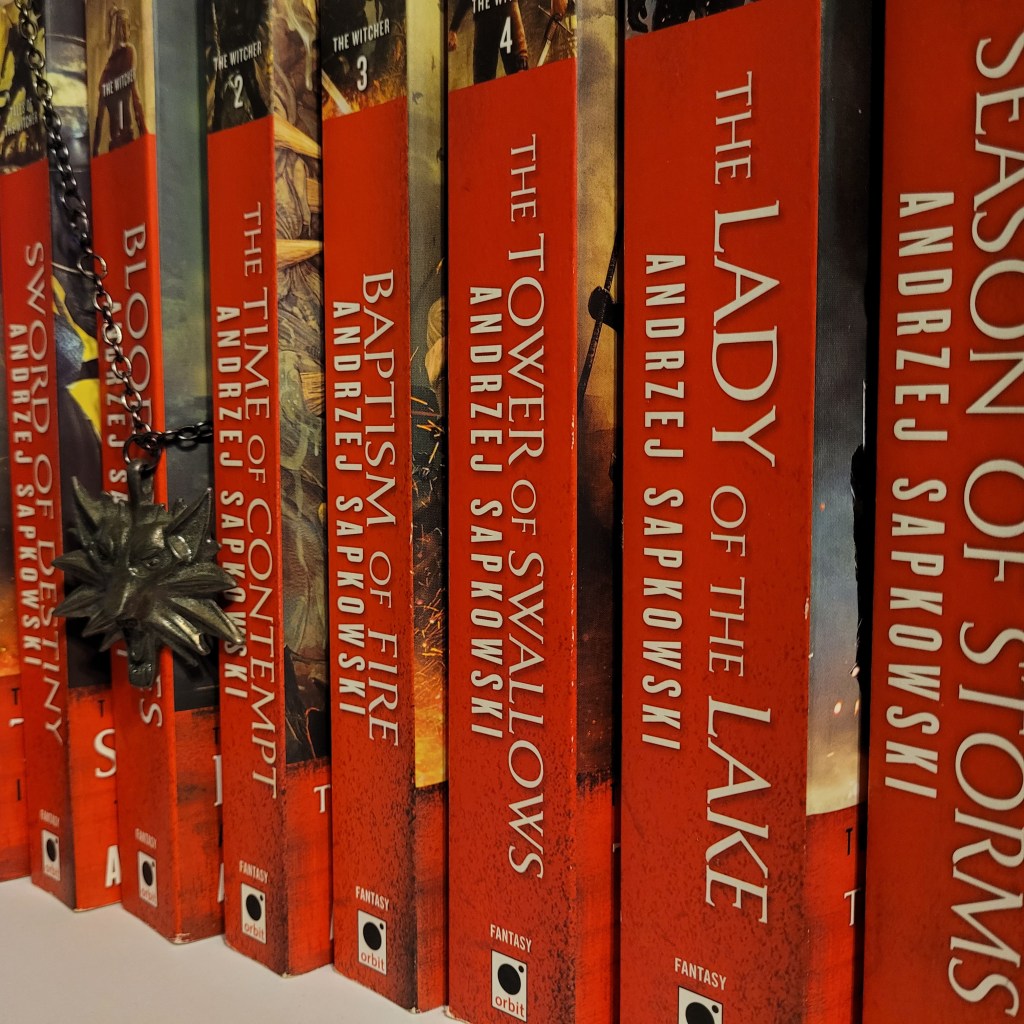
    It was through video games I first encountered the world of the witcher. I’d seen praise for the second witcher game online and picked it up to play it myself. I slammed through it twice to see both sides of the major branching storyline and immediately told my brother he should give it a try. I received the third witcher game as a gift one year and it coincided with a week of vacation time I’d taken from work around the holidays. I played it every day for an obscene amount of hours, so entirely did it capture me (and so empty was my schedule at the time). I enjoyed it so much, I ordered the written works and devoured them. At the time, the series’ conclusion The Lady of the Lake wasn’t officially translated, so I waited for its release with excitement.

    When I heard news of Netlfix adapting the books, I had some cautious excitement. When Henry Cavill was announced as Geralt and it became apparent how much of a fan he was of the series, I was elated. And, for me, that first season didn’t disappoint. I was excited to see what they’d do going forward.

    Well. We have a second season now, and it’s … polarizing. That seems like the kindest word. Let’s talk about why.

    Adaptation: Changes Necessary

    When taking a piece of media and translating it to another medium, there has to be some changes. Things that are interesting to read aren’t as grabbing when watched. Tension that exists in a visual medium can be lost when read without expansion or alteration. It’s simple fact.

    But while change can enhance the experience, it can also be destructive.

    In season 1 of the show, there are many minor and major changes to the source material, some of which I find make the stories stronger. For example, the Question of Price short story and its corresponding episode Of Banquets, Bastards, and Burials. In Sapkowski’s short story, Geralt is at the ball at the behest of Queen Calanthe, who wants to procure his services for a task she will provide almost no details of. Geralt is reluctant, to say the least, as he has his own scruples about what he will and won’t do for coin. In the show, Jaskier invites Geralt to the ball, and when his reputation as a witcher becomes known, that’s when Calanthe tries to purchase his services.

    I like this change for a number of reasons. In the short story, it’s clear that Geralt has a reputation, but Calanthe thinks that with enough coin she can buy Geralt out of his morals. In the short story, she’s invited someone to the banquet she cannot be sure of, on a night that will determine the future of her kingdom and her daughter’s life. Geralt being present by coincidence and her attempt to gain his allegiance before Duny arrives, to me, seems like a smarter move for a queen as shrewd and calculating as Calanthe.

    And the end of the episode even has stronger characterization for Geralt. In the show, they maintain the consistency that Geralt has in the short story collections as to his disregard for the concept of destiny. He off-handedly asks for payment in the Law of Surprise at Duny’s insistence and immediately doesn’t want anything to do with it. In the short story, Geralt says that Child-Surprises are required to make witchers and he’s hopeful he’ll get one. I think this moment is monumentally better in the show than the short story.

    Other changes exist in the show I can at least make sense of. There’s a reason behind them I can understand after some thought. Another example from the first season, the timeline shenanigans. The short stories have no clue as to their chronology either, but there is a present-day framing device behind them all. In the show, I can understand their mixed timelines as a vehicle for having the series’ principal actors in nearly every episode. Yen’s backstory is just hints and speculation in the books, and expanding that for the show certainly is a sensible decision, as she’s going to be one of the most important characters. However, I do think the show didn’t need to be so secretive about the timelines. Having the background knowledge I did going into the show I knew immediately what was happening, but I think the confusion for unfamiliar audiences was unnecessary. But, again, I can at least understand why the show made that decision.

    Then there was the changes in the second season.

    Destructive Deviation

    While there are still changes in season two I can fit under the umbrella of “necessary for television,” there are plenty of others I cannot fathom. Most of my complaints stem from a complete departure from a character’s established personality into something entirely different, something so extreme I can’t imagine how they’ll reconcile the changes with the story going forward.

    The biggest offender is, obviously, Yennefer. Yen from the books would never begin to consider the idea of trading Ciri for her magic. Within days of training her at the Temple of Melitele she straight up starts calling her “my daughter.” She loves her unconditionally. In season 1, the show even set this up. Yen regrets trading her ability to have children for magic. She wants to enslave a djinn to undo that loss. Even consistent to the show, Yen considering sacrificing Ciri for magic doesn’t follow, at least not for me.

    This problem extends to someone like Vesemir. In the books, our old grandpa witcher has no desire whatsoever to put any children through the Trial of Grasses to make another witcher. Him considering in the show, however, isn’t entirely without reason. The show’s set up a new kind of monster entering the world through their monoliths, and needing more witchers to fight these new monsters, I could see Vesemir reluctantly trying to make more. But I don’t think he’d do it with Ciri. And, even worse, if Ciri’s blood is the key to making more, why would he let her be the first attempt when it’s very unlikely she will survive because of how deadly the Trial of Grasses is.

    How on earth can Ciri reasonably reconcile with these two? Yen in the books becomes a surrogate mother to her, but how can anyone trust someone who was trying to sacrifice them to an ancient evil for their own gain? I don’t think helping reverse the situation she caused is enough. And once she truly appreciates the danger of the Trial of Grasses, will she accept that Vesemir was so easily swayed by a child’s argument to let her try it?

    Even characters as minor as Eskel or Lambert weren’t spared the brunt of these changes. Eskel’s not a large presence in the books – he helps train Ciri in Blood of Elves, and I don’t think he shows up again. He’s in the games and he’s well-liked. They killed him in the show to elicit a reaction, but they did nothing to actually cultivate any attachment to this character. By all intents and purposes, he’s just another guy with the same name as the character the fans of the games know. He has an entirely different personality. It could’ve been a witcher with no name or a name invented for the show, and nothing would’ve changed. Lambert, in the books and games, is more of a playful prick. In the show, he’s just been a bully to Ciri.

    I feel the need to clarify that I do not fault any of the actors for these occurrences at all. I think they’ve done the best they could with what they’ve received. I don’t like that Yennefer is cursing every seventh word in the second season and using such inspired epithets as “Fire-fucker,” but that’s not the fault of the actors.

    I could go on and on about other changes to characters and plots (just ask my brothers and friends), but it’s more of the same as above. I just want to briefly mention a worry I have for the show going forward.

    Mistaking the Stars Reflected in a Pond for those in the Heavens

    These characters, after this season, are simply not the same as the ones in the books. That’s the full stop. They’ve been changed. It’s not impossible there’s a road to get them back to their book characterization, but that’s not who they are right now.

    The problem I am worried will plague this show’s future is an inability to accept this.

    The future seasons of this show will suffer horrendously if all the resolution for Yennefer’s actions with Voleth Meir and Ciri is a single meaningful conversation and some emotional music. And then they’re as thick as they are in the books? It will feel unearned. It will add negative value to the audience investment. Actions have to have consequences.

    The creators of the show have deviated from the blueprint. If they try to bludgeon their way back on track ignoring what they’ve done, no one will be able to trust the storytelling of this show.

    To borrow a line from Vilgefortz (from the books, as he’s yet to say so in the show), the show’s creative team is mistaking the stars reflected in a pond at night for those in the heavens. I hope only they’ll have the wherewithal to look skyward before the potential of this adaption is rotted out from underneath it.

    Thank you for reading. At the very least, it’s helped me to write this all out. I hope you’ve all had wonderful holidays and a Happy New Year to you.

  • Ebonskar and What’s Next

    Ebonskar and What’s Next

    So! There it is. Ebonskar will be out on November 18th. I’m excited for it to get into your hands and I hope you enjoy it. I believe it’s my best work so far, and I can’t wait to see how everyone else feels about it.

    That just leaves one question, doesn’t it?

    What’s next?

    Well. There’s at least a half dozen people hungry for Red Watch’s third installment. If that’s you, thank you for being patient while I went and did this second thing. Let me say you’ve waited long enough, and to apologize in advance that the wait is going to be a little longer. Red Watch 3 will absolutely be commanding my attention until it’s finished, but it’s not done yet. There’s going to be a bit more time to wait, and I’m going to do what I can to mitigate it as much as I can.

    Following that, I’m not certain yet. My current plan finds Red Watch reaching its end in the fourth book, but I think I’ll want to land on something between the third and fourth. I have two sequels in early stages to follow Ebonskar to make a trilogy. If people are dying to see the follow up there, I could see Tyrant’s Mask 2 as the book following. Otherwise, one of those little ideas I played with earlier this year. It’d be nice to have a standalone available for others to ease in, see if they’re interested in my writing style.

    The blog will proceed as is. I’ll post when I’ve got something I want to say, or an event to inform you about. As with my last post, I’m not going to call out each one on social media, so if you want to get updates for each of the blog entries emailed to you, use the option on the right to subscribe. Emails will only come through when a blog post goes up.

    Thanks for reading; I hope you enjoy Ebonskar!