Category: media

  • The Witcher: The Lesser Evil

    The Witcher: The Lesser Evil

    Sapkowski’s The Last Wish is a favorite of mine. I don’t often reread books, but after the second season of The Witcher on Netflix released, I revisited this one. One of my favorite short stories in the collection is The Lesser Evil, and I doubt it’s a coincidence that it’s what Netflix chose to adapt for their first episode of the series.

    If you’re unfamiliar with it, I genuinely recommend picking up The Last Wish and giving it a read, or at least watching that episode of the show.

    I want to talk about something from that story that I’ve seen be … misunderstood by a few people. Something that’s taken out of context and bandied like it means exactly what it says. Major spoilers for The Lesser Evil below.

    The Context

    In the short story, Geralt arrives in Blaviken and reunites with an old acquaintance who invites him to stay in his home. On his way into town, Geralt came across a monster and slayed it. He hoped there might be a contract for it in the town, but there isn’t. He’s about to throw it’s carcass out, when some of the townspeople mention that a wizard in town might have a use for the thing. Geralt decides to try his luck.

    The wizard doesn’t want it. But he does want to hire Geralt for another monster that’s been chasing him. He talks about a Curse of the Black Sun, that women born during an eclipse are mutated, cursed, or possessed by demons. The wizard had encountered such a one, and tried to have the girl executed, but she escaped. He asks Geralt to kill her before she can try to hunt for him here, in Blaviken, and by her presence, lock him in his tower. Geralt doesn’t kill people for money, only monsters, and Stregobor pleads that he needs to compromise, as the wizards of old did when the curse first came around, and choose the lesser evil.

    “Evil is evil, Stregobor,” said the witcher seriously as he got up. “Lesser, greater, middling, it’s all the same. Proportions are negotiated, boundaries blurred. I’m not a pious hermit. I haven’t done only good in my life. But if I’m to choose between one evil and another, then I prefer not to choose at all.”

    Renfri, the girl allegedly cursed by the eclipse, speaks with him later. The legend behind the curse ruined her life, she was a princess, but Stregobor telling her family of the curse got her thrown out of the castle. She’s fought to survive, killed to avoid being killed, stolen to satiate starvation. She asks Geralt to kill Stregobor, as a lesser evil, and Geralt refuses again, saying he doesn’t believe in a lesser evil.

    “You don’t believe in it, you say. Well you’re right, in a way. Only Evil and Greater Evil exist and beyond them, in the shadows, lurks True Evil. … And sometimes, True Evil seizes you by the throat and demands that you choose between it and another, slightly lesser, Evil.”

    So Renfri employs the Tridam Ultimatum. Her and her crew are going to kill people at the market until the wizard vacates his tower. Geralt, panicked, rushes to the market before it opens to stop them. It ends in slaughter, Geralt forced to kill Renfri and her crew. Stregobor would have let them eradicate the whole town before he left his tower, and Renfri would not leave until she at last had her revenge.

    The Evil of Inaction

    Geralt, in his obstinance, didn’t act. Despite his sympathy for Renfri. Despite his existing disdain for Stregobor. It sticks with him forever. By not acting, he allowed a greater evil. By choosing to refrain, he chose a greater evil.

    It’s crazy how often I’ve seen the quote thrown around without irony. The story very clearly shows how that philosophy just doesn’t work. Refusing to choose doesn’t mean you are absolved – after all, you haven’t refused to choose, you’ve just chosen to do nothing.

    We can’t always see what all the consequences of our actions might be. We can only try and make our decisions with empathy and love in mind. Strive always toward good. Even if it means the most you can do is choose the lesser of two evils.

  • How Elden Ring Could Perfect the Soulsborne Formula

    How Elden Ring Could Perfect the Soulsborne Formula

    I’ve been following the Soulsborne series since I was in high school. I didn’t pick up the series at the time, busy as I was with school and a few other games (spent a lot of time playing MMOs in high school), but a friend of mine had the game and played through it at my house, the go-to hangout spot. Just watching, I knew the series was something special. But I was of a mind that I’d get frustrated battering my head against the same bosses over and over again, and didn’t give the game a shot.

    When Dark Souls III released, I took the plunge. My worries of frustration were immediately snuffed. The game was fair first and foremost – it wasn’t like the major boss encounters in the MMOs I was playing, where bad performance from one group member could sink the whole attempt. It was just me and the boss. If I died, it was because I did something I shouldn’t have.

    Seeing how much I’d fallen into the game, a friend of mine gifted me Bloodborne, and I slammed through it hungrily. Through both games I settled into fighting evasively with a big sword, weaving around attacks to find my openings.

    That playstyle (and my lack of passion for the aesthetic) led me to bounce off of Sekiro, but spectating alone proved enough for me to appreciate the game. And hopefully I’ll come around on it eventually and give it another go.

    That response to Sekiro made Elden Ring’s announcement feel like the exact thing I wanted to hear from FromSoftware. It’s been my most anticipated game since 2019, and a month ago I finally got my hands on it.

    It did not disappoint.

    A Perfect Storm

    It’s been a week since I finished my first playthrough. And I do need to clarify first – I definitely started another character the following day and if my six completions of Dark Souls III are any indication, I’ll sink several more hours into Elden Ring before I set it aside entirely.

    I’m not here to discuss the story, though. No interest in spilling spoilers today. Instead, as you might have guessed from the title, I want to highlight the game’s design.

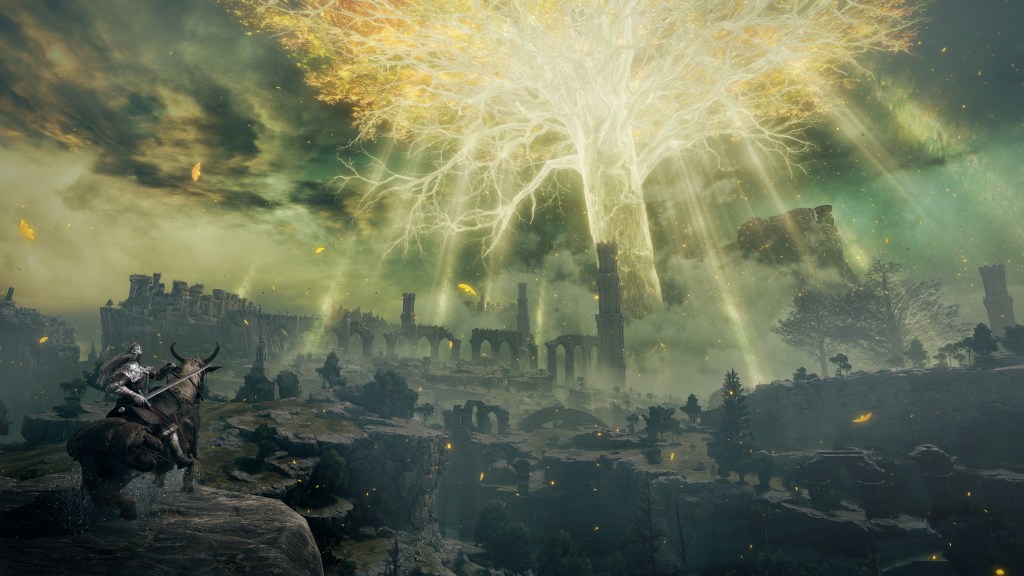
    Adding an open world to Elden Ring could’ve been a mixed bag. I think, ultimately, it’s vastly more beneficial than detrimental to the game. In previous Soulsborne entries, if you came to a difficult boss, it was a roadblock. There might be some optional areas, but for the most part, you needed to break down the barrier before your story could continue. Now, it doesn’t have to stall out your experience.

    I know the first time I encountered our friend the Fell Omen, I was not yet good enough at the game. I wasn’t used to the delays in the enemy swing times, I was dodging far too early, and I built to wield a big sword in two hands so I wasn’t parrying either. Margit whooped me. In another Souls entry, I might’ve been more prepared for that first boss, but in Elden Ring I wasn’t.

    But, after an undisclosed number of YOU DIED screens, I turned away from that fog wall and opened that map up again. I’d basically gone straight to Margit from the opening of the game. What else was out there anyway?

    A whole hell of a lot. I got better at the game, I leveled up, and I came back and got my revenge.

    There’s two ways to look at that experience. You could say that the difficult spikes in the game’s primary progression path are uneven to justify the open world. I prefer to look at the game as offering more paths to explore than I expected. I know people that returned Dark Souls III after hitting a roadblock on Iudex Gundyr, the first boss. If those players give Elden Ring more of a chance since they can travel elsewhere, it can only be good for the game.

    Open World Done Right

    For the most part, I’ve cooled on open-world style games. Every now and again, one will come along with innovations or a setting that catches my interest, but there’s a dozen Assassin’s Creed games and only one Breath of the Wild (for now). That piece of Elden Ring was the one thing that made me consider pumping the breaks. But, FromSoftware knows how to do it right.

    Gathering? I don’t know if I’ll ever be able to stomach a game that forces you to entirely stop moving to collect crafting materials after Elden Ring allowed me to sprint passed rowa bushes and flowers on horseback spamming to grab them all up. Crafting? I almost entirely ignored it, but I know the value that it has. The consumable items like throwable firebombs and weapon enhancements can be used so much more now that you can find items in the world to make more of them.

    Even FromSoftware’s own systems were iterated on in a new way. Getting more flasks for defeating powerful foes or groups of enemies made exploring much easier to sink into. Stakes of Marika allowing a respawn location outside of sites of grace (bonfires) is inspired. I absolutely dived into the open world bosses and areas without hesitation, even if I hadn’t found a traditional checkpoint in a while.

    And exploration was so rewarding in Elden Ring. Each small little dungeon had something interesting in it. Even if the aesthetics or bosses became repetitive, there was nearly always something about the delve that made it different from anywhere else you’d been. Finding a Cleanrot Knight in a cave before I’d begun encountering them in the world forced me to respect their moveset and learn how best to battle them with how I’d built my character. For me, it never got stale to explore the game.

    I’d be surprised if a game better than Elden Ring comes out this year. But even all my love for the experience doesn’t mean the game was perfect.

    The Shortcomings

    FromSoftware’s approach to storytelling has its ups and downs. Every single item and piece of dialogue can help illustrate the world and lore in such a mystifying and enticing way that leaves you hungry for the next discovery. The other side of that coin, however, is how easy it can be to miss something.

    In my playthrough, I’d already been to many of Elden Ring’s endgame areas and reached the final few bosses before my friends directed me to huge, incredible dungeons I wouldn’t have found otherwise. Having no direction to find those places – even when some of them were directly related to quests I’d begun with the game’s NPCs – can lead to so much missed content. It can be convoluted in a way that isn’t intuitive to follow.

    Between that and the other instances of open world exploration, my character ended up vastly over leveled for some sections of the game. While that same ability paved my path to success against Margit, it felt worse in these areas – because I hadn’t left them to come back to them stronger later on. I’d arrived already more powerful than I would’ve preferred to be. While I still fall on the more positive reception to the open world in Elden Ring, there is absolutely something to be said for the difficulty scaling FromSoftware is able to achieve in a linear experience.

    And, as another potential detriment of the open world, its vastness may prove to be a deterrent for repeat playthroughs. While I’ve already begun a second character myself, I absolutely struggle to imagine plaything Elden Ring as many times as I did Dark Souls III. That’s not to indicate that it isn’t worth the cost, though. My one completed playthrough clocked in just under half the total time I’d spent on Dark Souls III. It’s a vast experience with a lot on offer.

    Though I might be tempted skip Melania next time …

    Looking Forward

    In conclusion, there’s lessons I think FromSoftware can take from this ambitious project that, in my eyes, is an overwhelming success. Truthfully, if there’s one AAA developer that can leverage that opportunity to learn, I believe it’s FromSoftware. I’ve got my fingers crossed for some sweet DLC, but if that’s not in the cards, I’ll be there waiting for their next release.

    Now if you’ll excuse me, I need to go collect my runes.

  • The Batman

    I’ve been a fan of Batman my whole life – or at least as long as I can remember. The animated series is one of the first things I can remember seeing on TV. My dad had VHS copies of the Burton and Schumacher films that he indulgently watched with me several times. We saw each entry into Nolan’s Dark Knight trilogy together, I saw the Lego Batman Movie with my little sister, and now we have a new film released this past Friday.

    I don’t want to spill spoilers here, however, so all I will say on The Batman is that I genuinely enjoyed the film, though I am certainly not an unbiased source.

    Instead, I thought it would be fun to list out some comic runs that the movie most reminded me of, so that those of you who might be interested in further experiences of a Batman as presented in the film could have some places to look for it. After The Dark Knight and The Dark Knight Rises, I immediately fell into comics for several years, reading a lot of the most beloved runs of the Caped Crusader and picking up the at the time current run by Scott Snyder and Greg Capullo in the “New 52.”

    Here we go.

    Detective Focused Runs

    In these comics, Batman is pitted against a mystery with unclear answers that truly challenge his moniker of “World’s Greatest Detective.” I slot one of my all-time favorite comic runs into this category: Snyder and Capullo’s Court of Owls. It begins with a series of murders that Batman slowly discovers belie a greater conspiracy that reaches into the city’s very roots. Widely beloved, this series of comics is one I hope gets adapted into film, and I think our current Batman canon with Pattinson might be the perfect opportunity.

    Jeph Loeb and Tim Sale’s The Long Halloween is another incredible collection following an uncertain mystery with twists and turns and several appearances of some of Batman’s most beloved rogues. I will say, personally, I prefer the art of the more modern comics, and that ended up providing some (admittedly unfair) friction for me from this particular story. But don’t allow that dissuade you from one of the most iconic runs of Batman.

    Another favorite of mine, featuring a titan of the comics industry, is Batman: Hush. Written once again by Jeph Loeb but with art by the incredible Jim Lee, this story features Hush’s first appearance and includes many of Batman’s other rogues and even other heroes from DC’s universe. This comic has echoes of Loeb’s decade’s earlier Long Halloween, but finds new ground to tread and leaves everything fresh and exciting.

    Against Organized Crime

    A lot of the earlier Batman stories focused on his battle against the large crime families that through corruption and greed had a stranglehold over Gotham. Frank Miller and David Mazzucchelli’s Batman: Year One focuses on Bruce Wayne’s first attempts to strip away that rot. An excellent look at the origin of our Caped Crusader that has inspired many runs and films since.

    For another more recent run, the year-long weekly series Batman Eternal features Carmine Falcone as a premiere villain, having returned to Gotham to reclaim his lost empire. This series had several creators behind it, and had a wider lens overall to focus on several characters of Batman’s allegiances. These 52 issues have since been collected in various trades and an omnibus.

    Riddles, Riddles, Riddles

    If the movie left you hungry for more runs featuring the most matched intellect to oppose the Dark Knight, I would recommend once again, Snyder and Capullo. In their Zero Year run, Batman is pitted against the Riddler from the jump, though Batman doesn’t know it as quickly as the reader. Nearly everything this team managed during their five year run on the Batman mainline produced magic, and Zero Year quickly became a favorite of mine.

    Whatever your desire, I hope the above might provide some more Batman stories to those of you who might be looking for them. Thank you for reading, everyone! Now to flip on the signal and remind everyone he’s out there …

  • Adaptation and the Witcher

    Adaptation and the Witcher

    Spoiler Warning: this post contains major spoilers for Sapkowski’s The Last Wish, The Sword of Destiny, and Blood of Elves, with potentially minor spoilers for the rest of the series, and major spoilers for Netflix’s The Witcher seasons 1 and 2.

    Here at the beginning, I want to make it clear that I am in no way an authority on this subject. I am not a professional critic, I am an independent author with three works. I have, however, spent my entire life absorbing stories. From early on in my childhood, my favorite types of videos games were RPGs. I spent more time on the Elder Scrolls IV: Oblivion and Dragon Age: Origins than anyone else I knew in my teenage years. To this day, I find most of my enjoyment in media in the stories that are being told. As much as I love a game like Deep Rock Galactic, it’ll never satiate my need for experiencing a narrative as something like Divinity: Original Sin 2, which I’ve played through about two and a half times since I picked it up last year (and it’s a long game).

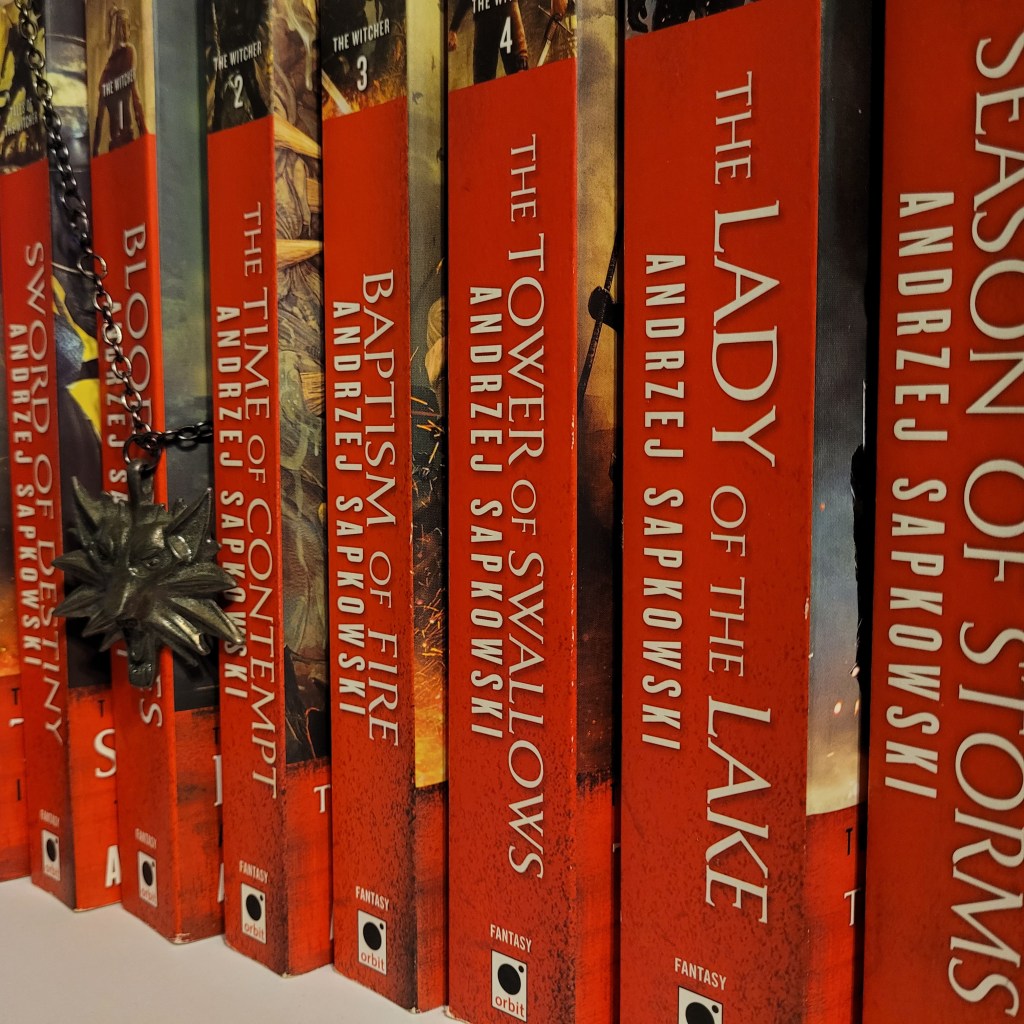
    It was through video games I first encountered the world of the witcher. I’d seen praise for the second witcher game online and picked it up to play it myself. I slammed through it twice to see both sides of the major branching storyline and immediately told my brother he should give it a try. I received the third witcher game as a gift one year and it coincided with a week of vacation time I’d taken from work around the holidays. I played it every day for an obscene amount of hours, so entirely did it capture me (and so empty was my schedule at the time). I enjoyed it so much, I ordered the written works and devoured them. At the time, the series’ conclusion The Lady of the Lake wasn’t officially translated, so I waited for its release with excitement.

    When I heard news of Netlfix adapting the books, I had some cautious excitement. When Henry Cavill was announced as Geralt and it became apparent how much of a fan he was of the series, I was elated. And, for me, that first season didn’t disappoint. I was excited to see what they’d do going forward.

    Well. We have a second season now, and it’s … polarizing. That seems like the kindest word. Let’s talk about why.

    Adaptation: Changes Necessary

    When taking a piece of media and translating it to another medium, there has to be some changes. Things that are interesting to read aren’t as grabbing when watched. Tension that exists in a visual medium can be lost when read without expansion or alteration. It’s simple fact.

    But while change can enhance the experience, it can also be destructive.

    In season 1 of the show, there are many minor and major changes to the source material, some of which I find make the stories stronger. For example, the Question of Price short story and its corresponding episode Of Banquets, Bastards, and Burials. In Sapkowski’s short story, Geralt is at the ball at the behest of Queen Calanthe, who wants to procure his services for a task she will provide almost no details of. Geralt is reluctant, to say the least, as he has his own scruples about what he will and won’t do for coin. In the show, Jaskier invites Geralt to the ball, and when his reputation as a witcher becomes known, that’s when Calanthe tries to purchase his services.

    I like this change for a number of reasons. In the short story, it’s clear that Geralt has a reputation, but Calanthe thinks that with enough coin she can buy Geralt out of his morals. In the short story, she’s invited someone to the banquet she cannot be sure of, on a night that will determine the future of her kingdom and her daughter’s life. Geralt being present by coincidence and her attempt to gain his allegiance before Duny arrives, to me, seems like a smarter move for a queen as shrewd and calculating as Calanthe.

    And the end of the episode even has stronger characterization for Geralt. In the show, they maintain the consistency that Geralt has in the short story collections as to his disregard for the concept of destiny. He off-handedly asks for payment in the Law of Surprise at Duny’s insistence and immediately doesn’t want anything to do with it. In the short story, Geralt says that Child-Surprises are required to make witchers and he’s hopeful he’ll get one. I think this moment is monumentally better in the show than the short story.

    Other changes exist in the show I can at least make sense of. There’s a reason behind them I can understand after some thought. Another example from the first season, the timeline shenanigans. The short stories have no clue as to their chronology either, but there is a present-day framing device behind them all. In the show, I can understand their mixed timelines as a vehicle for having the series’ principal actors in nearly every episode. Yen’s backstory is just hints and speculation in the books, and expanding that for the show certainly is a sensible decision, as she’s going to be one of the most important characters. However, I do think the show didn’t need to be so secretive about the timelines. Having the background knowledge I did going into the show I knew immediately what was happening, but I think the confusion for unfamiliar audiences was unnecessary. But, again, I can at least understand why the show made that decision.

    Then there was the changes in the second season.

    Destructive Deviation

    While there are still changes in season two I can fit under the umbrella of “necessary for television,” there are plenty of others I cannot fathom. Most of my complaints stem from a complete departure from a character’s established personality into something entirely different, something so extreme I can’t imagine how they’ll reconcile the changes with the story going forward.

    The biggest offender is, obviously, Yennefer. Yen from the books would never begin to consider the idea of trading Ciri for her magic. Within days of training her at the Temple of Melitele she straight up starts calling her “my daughter.” She loves her unconditionally. In season 1, the show even set this up. Yen regrets trading her ability to have children for magic. She wants to enslave a djinn to undo that loss. Even consistent to the show, Yen considering sacrificing Ciri for magic doesn’t follow, at least not for me.

    This problem extends to someone like Vesemir. In the books, our old grandpa witcher has no desire whatsoever to put any children through the Trial of Grasses to make another witcher. Him considering in the show, however, isn’t entirely without reason. The show’s set up a new kind of monster entering the world through their monoliths, and needing more witchers to fight these new monsters, I could see Vesemir reluctantly trying to make more. But I don’t think he’d do it with Ciri. And, even worse, if Ciri’s blood is the key to making more, why would he let her be the first attempt when it’s very unlikely she will survive because of how deadly the Trial of Grasses is.

    How on earth can Ciri reasonably reconcile with these two? Yen in the books becomes a surrogate mother to her, but how can anyone trust someone who was trying to sacrifice them to an ancient evil for their own gain? I don’t think helping reverse the situation she caused is enough. And once she truly appreciates the danger of the Trial of Grasses, will she accept that Vesemir was so easily swayed by a child’s argument to let her try it?

    Even characters as minor as Eskel or Lambert weren’t spared the brunt of these changes. Eskel’s not a large presence in the books – he helps train Ciri in Blood of Elves, and I don’t think he shows up again. He’s in the games and he’s well-liked. They killed him in the show to elicit a reaction, but they did nothing to actually cultivate any attachment to this character. By all intents and purposes, he’s just another guy with the same name as the character the fans of the games know. He has an entirely different personality. It could’ve been a witcher with no name or a name invented for the show, and nothing would’ve changed. Lambert, in the books and games, is more of a playful prick. In the show, he’s just been a bully to Ciri.

    I feel the need to clarify that I do not fault any of the actors for these occurrences at all. I think they’ve done the best they could with what they’ve received. I don’t like that Yennefer is cursing every seventh word in the second season and using such inspired epithets as “Fire-fucker,” but that’s not the fault of the actors.

    I could go on and on about other changes to characters and plots (just ask my brothers and friends), but it’s more of the same as above. I just want to briefly mention a worry I have for the show going forward.

    Mistaking the Stars Reflected in a Pond for those in the Heavens

    These characters, after this season, are simply not the same as the ones in the books. That’s the full stop. They’ve been changed. It’s not impossible there’s a road to get them back to their book characterization, but that’s not who they are right now.

    The problem I am worried will plague this show’s future is an inability to accept this.

    The future seasons of this show will suffer horrendously if all the resolution for Yennefer’s actions with Voleth Meir and Ciri is a single meaningful conversation and some emotional music. And then they’re as thick as they are in the books? It will feel unearned. It will add negative value to the audience investment. Actions have to have consequences.

    The creators of the show have deviated from the blueprint. If they try to bludgeon their way back on track ignoring what they’ve done, no one will be able to trust the storytelling of this show.

    To borrow a line from Vilgefortz (from the books, as he’s yet to say so in the show), the show’s creative team is mistaking the stars reflected in a pond at night for those in the heavens. I hope only they’ll have the wherewithal to look skyward before the potential of this adaption is rotted out from underneath it.

    Thank you for reading. At the very least, it’s helped me to write this all out. I hope you’ve all had wonderful holidays and a Happy New Year to you.