Tag: fantasy

  • RPGs: Beginning The Adventure

    RPGs: Beginning The Adventure

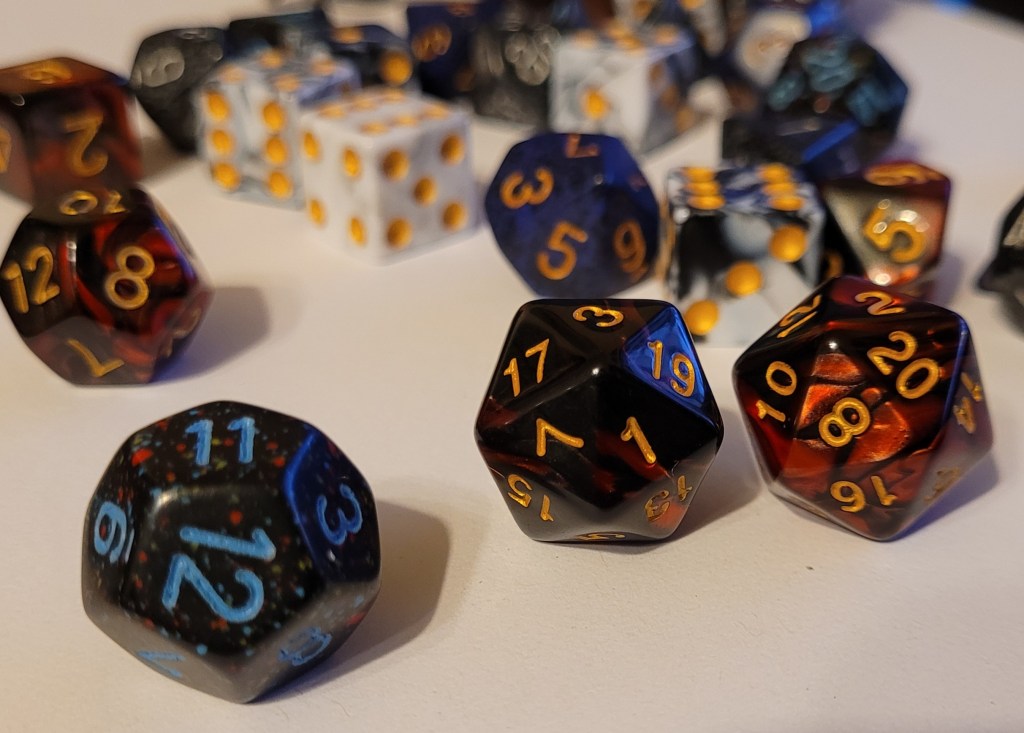
    Running a tabletop RPG for my friends is the most instantly gratifying creative experience I partake in. Each week I get immediate feedback on worldbuilding, narrative construction, character development, arena building, and several other things from people in a collaborative setting where the implicit goal is improving the experience for everyone present.

    I’ve written a handful of blog entries already about my love for this hobby, but none of them have provided much information that’s useful to begin running a game. That’s the goal today. I’ve started up at least a dozen games since my first time sitting behind the screen over a decade ago, two of which have actually reached a conclusion (which is rare, believe me), and I’ve thought a lot about ways to begin a game well.

    Here’s what I’ve got.

    Before the Beginning

    There’s a lot of things to consider before inviting everyone over and setting out the dice. The foundation, the first question, is, simply, “What is the adventure?” What is the driving action that throws the players’ characters together? The answer truly depends on how much work you want to do before the game begins. Running an adventure entirely from scratch (a “homebrew” game) isn’t right for every game master, and running from a published adventure is not inherently worse than a homebrew campaign in any way. I’ve run both in my tenure, using the Tyranny of Dragons two part module back in 5th edition’s infancy, and it was one of the two games I’ve run that ran to its conclusion.

    One of the best games I’ve had the privilege to be in as a player is my friend’s current game that started as a run of the Rime of the Frostmaiden module (which has now shifted into some homebrew after we reached the module’s conclusion and our DM wants to see if he can take a game to 20). Neither style is intrinsically more valuable than the other. It will all depend on the table.

    Where’s the Beginning?

    The backdrop for the start of your adventure is immensely important. For some players it will grow into a place that feels like home. Published adventures do a lot of legwork here, but even they can be improved.

    My best beginning towns have all provided a handful of smaller stakes hooks to pursue and investigate. I use them to determine what the table as a whole is most drawn to. In the game that inspired Ebonskar, sightings of hobgoblins had been noted by the town and the party had latched onto it pretty well – but their primary antagonist at the time was a hag that had just stolen a child.

    That’s not to discount a more linear beginning experience. When I ran Tyranny of Dragons, I used the opening straight from the book, with the party arriving at Greenrest as it was razed by the Cult of the Dragon and their blue ally in the sky. There’s several things I’d do differently if I ran that module again, but a lot of that attack on Greenrest would survive the transition.

    One of the most important things, unless your entire campaign is set in a big city, is to start somewhere that’s a shithole. My best towns – Borno’s Crossing, Saltwallow, Longmire – have all been in a decades-long slump. They’ve been forgotten towns that were once on a major roadway now bypassed by a trader’s highway or set in a forbidding locale that made them undesirable to visit. It helps to have that humble start, and it gives a lot of room for that first settlement to grow in response to the players’ actions. Even in big-city campaigns, beginning in the worse parts of town still aids in that feeling of becoming too big of a fish for the pond.

    Session Zero

    The first time you gather your party to venture forth, you really shouldn’t do much venturing at all.

    Seriously.

    Getting everyone together to lay the foundation for the game is massively important. It matters more than all the prep work in the world. It gets everyone on the same page, and can help you massively understand the type of game you’ll want to run for your table.

    You need to discuss what everyone’s idea for the game is. Do they want to be heroes that start from humble beginnings that go on to save the world? Do they want to fight liches and hydras and dragons, plumbing the depths of the darkest dungeons that ever were buried and forgotten? Or do they want to plan out the best party and make inroads with the nobility to affect change on a systemic scale?

    D&D might not be the perfect fit for every type of game out there. If you guys want to run something focusing less on delving into dungeons and swinging swords and spells at monsters, this is a good time to discuss other game systems.

    And you need to discuss what is and isn’t on the table. One of my current players has arachnophobia and asked that I avoid spiders as much as I could, while giving me the pass to use them occasionally. When they do show up, if he just says the word, I’ll stop describing their spindly little legs racing up and down the sides of the cavern walls or how restrictive the webbing is. It’ll be glossed over with no loss to the game. I have a few other things that aren’t going to be in the games I run, some rules that are hard and fast, and others that are malleable, at least to a degree. Listen carefully and take notes.

    Once you’ve got that squared away, you’ll be ready to truly begin your game. Just, one last thing …

    A Time and Place for Taverns

    Cliché, sure, but for good reason. Don’t let anyone rag on you for beginning your game in a tavern. It can be, and is, a perfect opening for many different games. I’ve started some that way, started many others, and some of my favorite times as a player began in taverns. Just because it’s been done before doesn’t mean it shouldn’t be done again.

    A lot of the alternatives I’ve seen presented online seem like going out of one’s way to avoid the tavern. Some ideas take a really specific group of players to work well. But even those aren’t without merit. Beginning in the midst of a siege with the players all needing to take up arms can be exciting! In Dimension 20’s Fantasy High, the players’ characters didn’t interact with one another much until they all ended up getting detention. (Which, when watching I figured they’d all be told beforehand to try and land themselves detention day one – but that still doesn’t detract from how effective it was to group the PCs together!) Even Critical Role’s 2nd campaign began in a tavern – if Matthew Mercer can “get away with it”, then maybe he’s not really “getting away” with anything.

    And, hey, maybe during session zero your players decided they just wanted to have known each other beforehand anyway.

    Before You Go

    A few last-last minute things I wanted to include here.

    First of all, remember that as the game master, you are still a player too. If you aren’t having fun, there’s something wrong. Find whatever you need to find to alleviate that.

    Second, there is a lot of times that bending or ignoring a rule can provide a fantastically cool moment. Go for it! The rules are guidelines, right? And everyone will talk about it forever! The inverse, however, is also true. There will be times that you need to enforce the rules, things that are too janky or overpowered that they can’t become part of the game. Try not to beat yourself up over it, even if you get them wrong on either side.

    As always, thank you for reading. Good luck out there, heroes.

  • D&D: Running Dragons

    D&D: Running Dragons

    When I first started running D&D, I managed to learn how to construct a dungeon with success fairly quickly. My players were quick to engage with these delves and I had no trouble discerning what was working and what wasn’t. But, there in the name lies something I felt was equally essential to the experience: dragons.

    It took me much longer to parse out a successful dragon encounter, given their relative rarity to the near ubiquitous dungeon. My first attempts were beasts that did not display the intelligence present by the stat arrays, going toe-to-toe with the warrior clad in plate armor instead of taking to the skies and raining fire or acid or lightning down upon them. My encounters were in barren, mostly circular caves not shaped in the least by the dragon’s whims or needs.

    I hope to save you some time and failures. Learn from my mistakes. Become the dragon your players will fear to engage.

    Fight and Flight

    Dragons have a natural tactical advantage over most playable character lineages in D&D – their natural ability to fly. There is no greater disservice you can do to your dragons and your players than to have their foe linger thereupon the ground, its wings forgotten. A calculating dragon might only ever choose to land when it believes its claws and teeth can prove the end of its target. Instead allow the dragon to focus on finding a position for its breath attack to cause the most damage, and landing only afterward to tear apart the foe most damaged by the discharge.

    In 5th edition, dragons were given the option of using their wings at the end of a foe’s turn, potentially knocking their assailants prone and taking to the skies once more. I prefer to allow the movement granted by this legendary action to supersede any movement speed reductions, like those from the sentinel feat. This allows the dragon to escape from a tight spot when needed, without entirely stripping the feature of sentinel should the dragon be choosing to shift away from such foes without using this action.

    Stay out of reach of the heaviest hitters, pick your targets to put them on the ground, and don’t linger beyond what’s necessary for the dragon to accomplish its goals. If the dragon is amused by the party, allow them the chance to recover. If its beginning to feel threatened, show the party no mercy.

    Minions

    The true threat any boss encounter in D&D fears is something outside of the scope of dice and decisions: the action economy. The number of creatures on either side of a battle influences the outcome like a finger on the scale. A dragon fighting alone, unless its of a much higher difficulty than the party can handle, has already accepted its death.

    To preserve the difficulty of such an encounter, grant your dragon minions and allies to help keep the fight in its favor – at least until those creatures have been slain. In my setting, dragons are supported by armies of soldiers – kobolds, lizardfolk, and dragonborn. A powerful martial fighter sworn to the dragon’s personal safety could be included in the fight. There are also the abishai, presented as fiendish creations of Tiamat in the hells that are sent to support her servants. Additionally, in my setting, many of the eggs in a dragon’s clutch hatch into offspring that are not full dragons. This is where guard drakes and other reptile-adjacent creatures come from. Your dragon could call to its young in such battles.

    Lairs and Arenas

    One of the most important pieces of any dragon encounter is the arena. Has the dragon flown out from the heart of its domain to a place it believes it can weaken the intruders challenging its claim? Does it lie in wait at the heart of its lair, resting upon a hoard that would make the richest kings blush?

    Each type of dragon is different, and would prefer different lairs to operate in. A black dragon with its amphibious nature would want a locale it can puts its enemies at a disadvantage by submerging itself in the murky depths of the waters. A white dragon would wish for a forbidding mountaintop cavern with icy stretches of floor that put any who would assail it at odds with unsure footing. A green dragon may wish to battle in an enclosed space that slowly fills with the poisonous gas it exhales with its breath attacks.

    A font of inspiration I’ve visited time and again for dragon arenas is the game Dragon Age: Inquisition. Every zone with a dragon battle managed to create a unique locale to encounter the creatures, with an excellent AI that uses the terrain around it to allow for a incredible and dynamic fight. Each of those lairs were immensely helpful when it came to designing my own encounter spaces for D&D.

    Expectations can be at an all-time high when it comes to a battle with a dragon in your D&D game. With these tips, I hope you’ll be able to create encounters that will be the talk of your table for years. Thank you for reading.

  • Adaptation and the Witcher

    Adaptation and the Witcher

    Spoiler Warning: this post contains major spoilers for Sapkowski’s The Last Wish, The Sword of Destiny, and Blood of Elves, with potentially minor spoilers for the rest of the series, and major spoilers for Netflix’s The Witcher seasons 1 and 2.

    Here at the beginning, I want to make it clear that I am in no way an authority on this subject. I am not a professional critic, I am an independent author with three works. I have, however, spent my entire life absorbing stories. From early on in my childhood, my favorite types of videos games were RPGs. I spent more time on the Elder Scrolls IV: Oblivion and Dragon Age: Origins than anyone else I knew in my teenage years. To this day, I find most of my enjoyment in media in the stories that are being told. As much as I love a game like Deep Rock Galactic, it’ll never satiate my need for experiencing a narrative as something like Divinity: Original Sin 2, which I’ve played through about two and a half times since I picked it up last year (and it’s a long game).

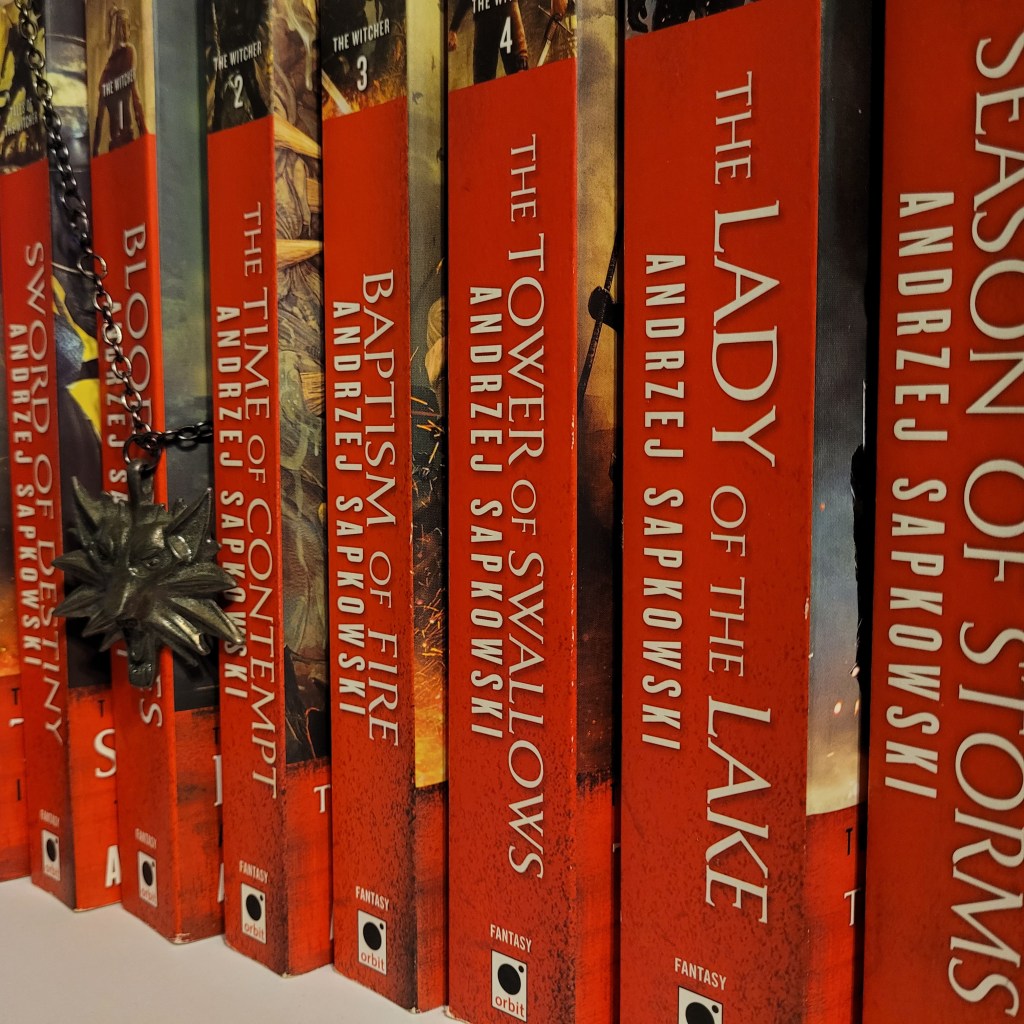
    It was through video games I first encountered the world of the witcher. I’d seen praise for the second witcher game online and picked it up to play it myself. I slammed through it twice to see both sides of the major branching storyline and immediately told my brother he should give it a try. I received the third witcher game as a gift one year and it coincided with a week of vacation time I’d taken from work around the holidays. I played it every day for an obscene amount of hours, so entirely did it capture me (and so empty was my schedule at the time). I enjoyed it so much, I ordered the written works and devoured them. At the time, the series’ conclusion The Lady of the Lake wasn’t officially translated, so I waited for its release with excitement.

    When I heard news of Netlfix adapting the books, I had some cautious excitement. When Henry Cavill was announced as Geralt and it became apparent how much of a fan he was of the series, I was elated. And, for me, that first season didn’t disappoint. I was excited to see what they’d do going forward.

    Well. We have a second season now, and it’s … polarizing. That seems like the kindest word. Let’s talk about why.

    Adaptation: Changes Necessary

    When taking a piece of media and translating it to another medium, there has to be some changes. Things that are interesting to read aren’t as grabbing when watched. Tension that exists in a visual medium can be lost when read without expansion or alteration. It’s simple fact.

    But while change can enhance the experience, it can also be destructive.

    In season 1 of the show, there are many minor and major changes to the source material, some of which I find make the stories stronger. For example, the Question of Price short story and its corresponding episode Of Banquets, Bastards, and Burials. In Sapkowski’s short story, Geralt is at the ball at the behest of Queen Calanthe, who wants to procure his services for a task she will provide almost no details of. Geralt is reluctant, to say the least, as he has his own scruples about what he will and won’t do for coin. In the show, Jaskier invites Geralt to the ball, and when his reputation as a witcher becomes known, that’s when Calanthe tries to purchase his services.

    I like this change for a number of reasons. In the short story, it’s clear that Geralt has a reputation, but Calanthe thinks that with enough coin she can buy Geralt out of his morals. In the short story, she’s invited someone to the banquet she cannot be sure of, on a night that will determine the future of her kingdom and her daughter’s life. Geralt being present by coincidence and her attempt to gain his allegiance before Duny arrives, to me, seems like a smarter move for a queen as shrewd and calculating as Calanthe.

    And the end of the episode even has stronger characterization for Geralt. In the show, they maintain the consistency that Geralt has in the short story collections as to his disregard for the concept of destiny. He off-handedly asks for payment in the Law of Surprise at Duny’s insistence and immediately doesn’t want anything to do with it. In the short story, Geralt says that Child-Surprises are required to make witchers and he’s hopeful he’ll get one. I think this moment is monumentally better in the show than the short story.

    Other changes exist in the show I can at least make sense of. There’s a reason behind them I can understand after some thought. Another example from the first season, the timeline shenanigans. The short stories have no clue as to their chronology either, but there is a present-day framing device behind them all. In the show, I can understand their mixed timelines as a vehicle for having the series’ principal actors in nearly every episode. Yen’s backstory is just hints and speculation in the books, and expanding that for the show certainly is a sensible decision, as she’s going to be one of the most important characters. However, I do think the show didn’t need to be so secretive about the timelines. Having the background knowledge I did going into the show I knew immediately what was happening, but I think the confusion for unfamiliar audiences was unnecessary. But, again, I can at least understand why the show made that decision.

    Then there was the changes in the second season.

    Destructive Deviation

    While there are still changes in season two I can fit under the umbrella of “necessary for television,” there are plenty of others I cannot fathom. Most of my complaints stem from a complete departure from a character’s established personality into something entirely different, something so extreme I can’t imagine how they’ll reconcile the changes with the story going forward.

    The biggest offender is, obviously, Yennefer. Yen from the books would never begin to consider the idea of trading Ciri for her magic. Within days of training her at the Temple of Melitele she straight up starts calling her “my daughter.” She loves her unconditionally. In season 1, the show even set this up. Yen regrets trading her ability to have children for magic. She wants to enslave a djinn to undo that loss. Even consistent to the show, Yen considering sacrificing Ciri for magic doesn’t follow, at least not for me.

    This problem extends to someone like Vesemir. In the books, our old grandpa witcher has no desire whatsoever to put any children through the Trial of Grasses to make another witcher. Him considering in the show, however, isn’t entirely without reason. The show’s set up a new kind of monster entering the world through their monoliths, and needing more witchers to fight these new monsters, I could see Vesemir reluctantly trying to make more. But I don’t think he’d do it with Ciri. And, even worse, if Ciri’s blood is the key to making more, why would he let her be the first attempt when it’s very unlikely she will survive because of how deadly the Trial of Grasses is.

    How on earth can Ciri reasonably reconcile with these two? Yen in the books becomes a surrogate mother to her, but how can anyone trust someone who was trying to sacrifice them to an ancient evil for their own gain? I don’t think helping reverse the situation she caused is enough. And once she truly appreciates the danger of the Trial of Grasses, will she accept that Vesemir was so easily swayed by a child’s argument to let her try it?

    Even characters as minor as Eskel or Lambert weren’t spared the brunt of these changes. Eskel’s not a large presence in the books – he helps train Ciri in Blood of Elves, and I don’t think he shows up again. He’s in the games and he’s well-liked. They killed him in the show to elicit a reaction, but they did nothing to actually cultivate any attachment to this character. By all intents and purposes, he’s just another guy with the same name as the character the fans of the games know. He has an entirely different personality. It could’ve been a witcher with no name or a name invented for the show, and nothing would’ve changed. Lambert, in the books and games, is more of a playful prick. In the show, he’s just been a bully to Ciri.

    I feel the need to clarify that I do not fault any of the actors for these occurrences at all. I think they’ve done the best they could with what they’ve received. I don’t like that Yennefer is cursing every seventh word in the second season and using such inspired epithets as “Fire-fucker,” but that’s not the fault of the actors.

    I could go on and on about other changes to characters and plots (just ask my brothers and friends), but it’s more of the same as above. I just want to briefly mention a worry I have for the show going forward.

    Mistaking the Stars Reflected in a Pond for those in the Heavens

    These characters, after this season, are simply not the same as the ones in the books. That’s the full stop. They’ve been changed. It’s not impossible there’s a road to get them back to their book characterization, but that’s not who they are right now.

    The problem I am worried will plague this show’s future is an inability to accept this.

    The future seasons of this show will suffer horrendously if all the resolution for Yennefer’s actions with Voleth Meir and Ciri is a single meaningful conversation and some emotional music. And then they’re as thick as they are in the books? It will feel unearned. It will add negative value to the audience investment. Actions have to have consequences.

    The creators of the show have deviated from the blueprint. If they try to bludgeon their way back on track ignoring what they’ve done, no one will be able to trust the storytelling of this show.

    To borrow a line from Vilgefortz (from the books, as he’s yet to say so in the show), the show’s creative team is mistaking the stars reflected in a pond at night for those in the heavens. I hope only they’ll have the wherewithal to look skyward before the potential of this adaption is rotted out from underneath it.

    Thank you for reading. At the very least, it’s helped me to write this all out. I hope you’ve all had wonderful holidays and a Happy New Year to you.