Spoiler Warning: this post contains major spoilers for Sapkowski’s The Last Wish, The Sword of Destiny, and Blood of Elves, with potentially minor spoilers for the rest of the series, and major spoilers for Netflix’s The Witcher seasons 1 and 2.
Here at the beginning, I want to make it clear that I am in no way an authority on this subject. I am not a professional critic, I am an independent author with three works. I have, however, spent my entire life absorbing stories. From early on in my childhood, my favorite types of videos games were RPGs. I spent more time on the Elder Scrolls IV: Oblivion and Dragon Age: Origins than anyone else I knew in my teenage years. To this day, I find most of my enjoyment in media in the stories that are being told. As much as I love a game like Deep Rock Galactic, it’ll never satiate my need for experiencing a narrative as something like Divinity: Original Sin 2, which I’ve played through about two and a half times since I picked it up last year (and it’s a long game).
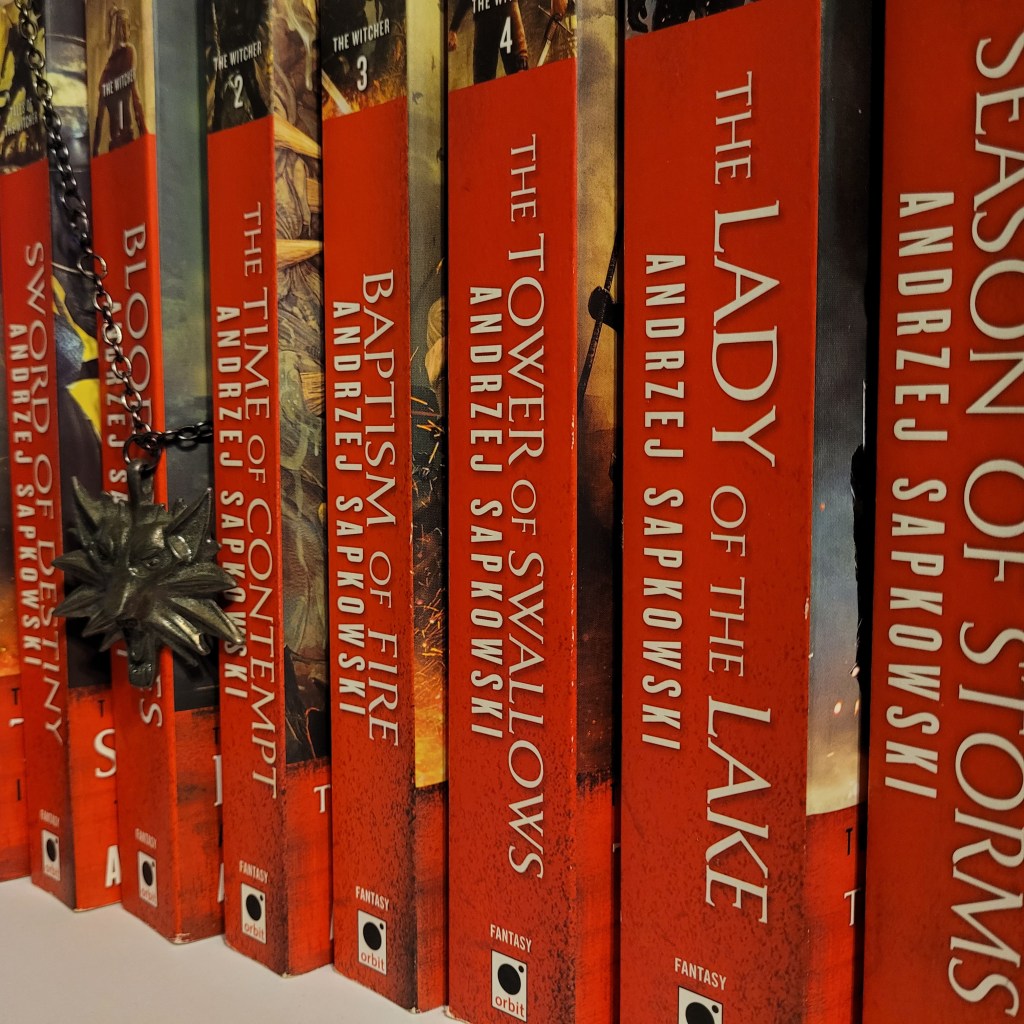
It was through video games I first encountered the world of the witcher. I’d seen praise for the second witcher game online and picked it up to play it myself. I slammed through it twice to see both sides of the major branching storyline and immediately told my brother he should give it a try. I received the third witcher game as a gift one year and it coincided with a week of vacation time I’d taken from work around the holidays. I played it every day for an obscene amount of hours, so entirely did it capture me (and so empty was my schedule at the time). I enjoyed it so much, I ordered the written works and devoured them. At the time, the series’ conclusion The Lady of the Lake wasn’t officially translated, so I waited for its release with excitement.
When I heard news of Netlfix adapting the books, I had some cautious excitement. When Henry Cavill was announced as Geralt and it became apparent how much of a fan he was of the series, I was elated. And, for me, that first season didn’t disappoint. I was excited to see what they’d do going forward.
Well. We have a second season now, and it’s … polarizing. That seems like the kindest word. Let’s talk about why.
Adaptation: Changes Necessary
When taking a piece of media and translating it to another medium, there has to be some changes. Things that are interesting to read aren’t as grabbing when watched. Tension that exists in a visual medium can be lost when read without expansion or alteration. It’s simple fact.
But while change can enhance the experience, it can also be destructive.
In season 1 of the show, there are many minor and major changes to the source material, some of which I find make the stories stronger. For example, the Question of Price short story and its corresponding episode Of Banquets, Bastards, and Burials. In Sapkowski’s short story, Geralt is at the ball at the behest of Queen Calanthe, who wants to procure his services for a task she will provide almost no details of. Geralt is reluctant, to say the least, as he has his own scruples about what he will and won’t do for coin. In the show, Jaskier invites Geralt to the ball, and when his reputation as a witcher becomes known, that’s when Calanthe tries to purchase his services.
I like this change for a number of reasons. In the short story, it’s clear that Geralt has a reputation, but Calanthe thinks that with enough coin she can buy Geralt out of his morals. In the short story, she’s invited someone to the banquet she cannot be sure of, on a night that will determine the future of her kingdom and her daughter’s life. Geralt being present by coincidence and her attempt to gain his allegiance before Duny arrives, to me, seems like a smarter move for a queen as shrewd and calculating as Calanthe.
And the end of the episode even has stronger characterization for Geralt. In the show, they maintain the consistency that Geralt has in the short story collections as to his disregard for the concept of destiny. He off-handedly asks for payment in the Law of Surprise at Duny’s insistence and immediately doesn’t want anything to do with it. In the short story, Geralt says that Child-Surprises are required to make witchers and he’s hopeful he’ll get one. I think this moment is monumentally better in the show than the short story.
Other changes exist in the show I can at least make sense of. There’s a reason behind them I can understand after some thought. Another example from the first season, the timeline shenanigans. The short stories have no clue as to their chronology either, but there is a present-day framing device behind them all. In the show, I can understand their mixed timelines as a vehicle for having the series’ principal actors in nearly every episode. Yen’s backstory is just hints and speculation in the books, and expanding that for the show certainly is a sensible decision, as she’s going to be one of the most important characters. However, I do think the show didn’t need to be so secretive about the timelines. Having the background knowledge I did going into the show I knew immediately what was happening, but I think the confusion for unfamiliar audiences was unnecessary. But, again, I can at least understand why the show made that decision.
Then there was the changes in the second season.
Destructive Deviation
While there are still changes in season two I can fit under the umbrella of “necessary for television,” there are plenty of others I cannot fathom. Most of my complaints stem from a complete departure from a character’s established personality into something entirely different, something so extreme I can’t imagine how they’ll reconcile the changes with the story going forward.
The biggest offender is, obviously, Yennefer. Yen from the books would never begin to consider the idea of trading Ciri for her magic. Within days of training her at the Temple of Melitele she straight up starts calling her “my daughter.” She loves her unconditionally. In season 1, the show even set this up. Yen regrets trading her ability to have children for magic. She wants to enslave a djinn to undo that loss. Even consistent to the show, Yen considering sacrificing Ciri for magic doesn’t follow, at least not for me.
This problem extends to someone like Vesemir. In the books, our old grandpa witcher has no desire whatsoever to put any children through the Trial of Grasses to make another witcher. Him considering in the show, however, isn’t entirely without reason. The show’s set up a new kind of monster entering the world through their monoliths, and needing more witchers to fight these new monsters, I could see Vesemir reluctantly trying to make more. But I don’t think he’d do it with Ciri. And, even worse, if Ciri’s blood is the key to making more, why would he let her be the first attempt when it’s very unlikely she will survive because of how deadly the Trial of Grasses is.
How on earth can Ciri reasonably reconcile with these two? Yen in the books becomes a surrogate mother to her, but how can anyone trust someone who was trying to sacrifice them to an ancient evil for their own gain? I don’t think helping reverse the situation she caused is enough. And once she truly appreciates the danger of the Trial of Grasses, will she accept that Vesemir was so easily swayed by a child’s argument to let her try it?
Even characters as minor as Eskel or Lambert weren’t spared the brunt of these changes. Eskel’s not a large presence in the books – he helps train Ciri in Blood of Elves, and I don’t think he shows up again. He’s in the games and he’s well-liked. They killed him in the show to elicit a reaction, but they did nothing to actually cultivate any attachment to this character. By all intents and purposes, he’s just another guy with the same name as the character the fans of the games know. He has an entirely different personality. It could’ve been a witcher with no name or a name invented for the show, and nothing would’ve changed. Lambert, in the books and games, is more of a playful prick. In the show, he’s just been a bully to Ciri.
I feel the need to clarify that I do not fault any of the actors for these occurrences at all. I think they’ve done the best they could with what they’ve received. I don’t like that Yennefer is cursing every seventh word in the second season and using such inspired epithets as “Fire-fucker,” but that’s not the fault of the actors.
I could go on and on about other changes to characters and plots (just ask my brothers and friends), but it’s more of the same as above. I just want to briefly mention a worry I have for the show going forward.
Mistaking the Stars Reflected in a Pond for those in the Heavens
These characters, after this season, are simply not the same as the ones in the books. That’s the full stop. They’ve been changed. It’s not impossible there’s a road to get them back to their book characterization, but that’s not who they are right now.
The problem I am worried will plague this show’s future is an inability to accept this.
The future seasons of this show will suffer horrendously if all the resolution for Yennefer’s actions with Voleth Meir and Ciri is a single meaningful conversation and some emotional music. And then they’re as thick as they are in the books? It will feel unearned. It will add negative value to the audience investment. Actions have to have consequences.
The creators of the show have deviated from the blueprint. If they try to bludgeon their way back on track ignoring what they’ve done, no one will be able to trust the storytelling of this show.
To borrow a line from Vilgefortz (from the books, as he’s yet to say so in the show), the show’s creative team is mistaking the stars reflected in a pond at night for those in the heavens. I hope only they’ll have the wherewithal to look skyward before the potential of this adaption is rotted out from underneath it.
Thank you for reading. At the very least, it’s helped me to write this all out. I hope you’ve all had wonderful holidays and a Happy New Year to you.



 Ben Stovall Blog