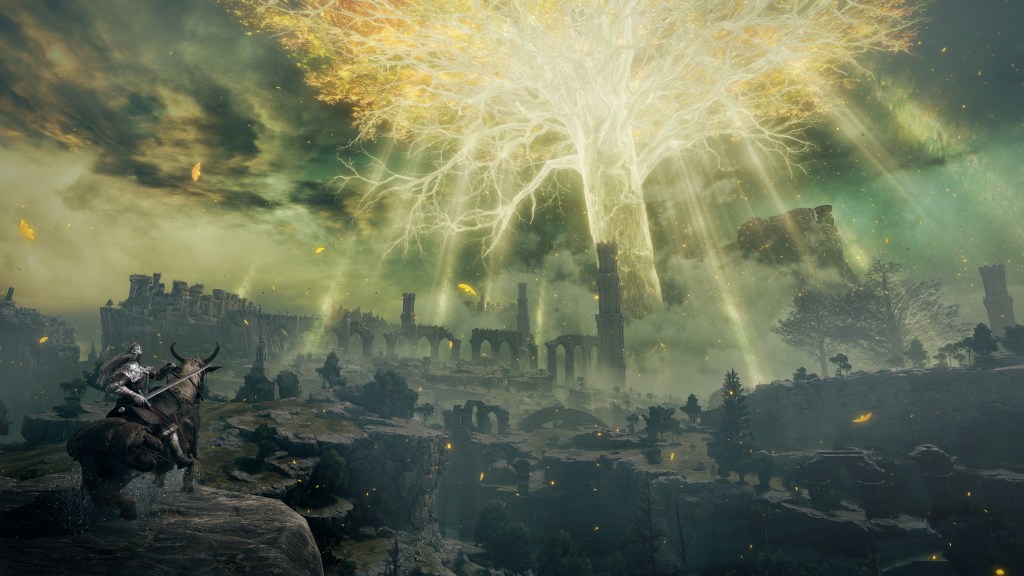
I’ve been following the Soulsborne series since I was in high school. I didn’t pick up the series at the time, busy as I was with school and a few other games (spent a lot of time playing MMOs in high school), but a friend of mine had the game and played through it at my house, the go-to hangout spot. Just watching, I knew the series was something special. But I was of a mind that I’d get frustrated battering my head against the same bosses over and over again, and didn’t give the game a shot.
When Dark Souls III released, I took the plunge. My worries of frustration were immediately snuffed. The game was fair first and foremost – it wasn’t like the major boss encounters in the MMOs I was playing, where bad performance from one group member could sink the whole attempt. It was just me and the boss. If I died, it was because I did something I shouldn’t have.
Seeing how much I’d fallen into the game, a friend of mine gifted me Bloodborne, and I slammed through it hungrily. Through both games I settled into fighting evasively with a big sword, weaving around attacks to find my openings.
That playstyle (and my lack of passion for the aesthetic) led me to bounce off of Sekiro, but spectating alone proved enough for me to appreciate the game. And hopefully I’ll come around on it eventually and give it another go.
That response to Sekiro made Elden Ring’s announcement feel like the exact thing I wanted to hear from FromSoftware. It’s been my most anticipated game since 2019, and a month ago I finally got my hands on it.
It did not disappoint.
A Perfect Storm
It’s been a week since I finished my first playthrough. And I do need to clarify first – I definitely started another character the following day and if my six completions of Dark Souls III are any indication, I’ll sink several more hours into Elden Ring before I set it aside entirely.
I’m not here to discuss the story, though. No interest in spilling spoilers today. Instead, as you might have guessed from the title, I want to highlight the game’s design.
Adding an open world to Elden Ring could’ve been a mixed bag. I think, ultimately, it’s vastly more beneficial than detrimental to the game. In previous Soulsborne entries, if you came to a difficult boss, it was a roadblock. There might be some optional areas, but for the most part, you needed to break down the barrier before your story could continue. Now, it doesn’t have to stall out your experience.
I know the first time I encountered our friend the Fell Omen, I was not yet good enough at the game. I wasn’t used to the delays in the enemy swing times, I was dodging far too early, and I built to wield a big sword in two hands so I wasn’t parrying either. Margit whooped me. In another Souls entry, I might’ve been more prepared for that first boss, but in Elden Ring I wasn’t.
But, after an undisclosed number of YOU DIED screens, I turned away from that fog wall and opened that map up again. I’d basically gone straight to Margit from the opening of the game. What else was out there anyway?
A whole hell of a lot. I got better at the game, I leveled up, and I came back and got my revenge.
There’s two ways to look at that experience. You could say that the difficult spikes in the game’s primary progression path are uneven to justify the open world. I prefer to look at the game as offering more paths to explore than I expected. I know people that returned Dark Souls III after hitting a roadblock on Iudex Gundyr, the first boss. If those players give Elden Ring more of a chance since they can travel elsewhere, it can only be good for the game.
Open World Done Right
For the most part, I’ve cooled on open-world style games. Every now and again, one will come along with innovations or a setting that catches my interest, but there’s a dozen Assassin’s Creed games and only one Breath of the Wild (for now). That piece of Elden Ring was the one thing that made me consider pumping the breaks. But, FromSoftware knows how to do it right.
Gathering? I don’t know if I’ll ever be able to stomach a game that forces you to entirely stop moving to collect crafting materials after Elden Ring allowed me to sprint passed rowa bushes and flowers on horseback spamming to grab them all up. Crafting? I almost entirely ignored it, but I know the value that it has. The consumable items like throwable firebombs and weapon enhancements can be used so much more now that you can find items in the world to make more of them.
Even FromSoftware’s own systems were iterated on in a new way. Getting more flasks for defeating powerful foes or groups of enemies made exploring much easier to sink into. Stakes of Marika allowing a respawn location outside of sites of grace (bonfires) is inspired. I absolutely dived into the open world bosses and areas without hesitation, even if I hadn’t found a traditional checkpoint in a while.
And exploration was so rewarding in Elden Ring. Each small little dungeon had something interesting in it. Even if the aesthetics or bosses became repetitive, there was nearly always something about the delve that made it different from anywhere else you’d been. Finding a Cleanrot Knight in a cave before I’d begun encountering them in the world forced me to respect their moveset and learn how best to battle them with how I’d built my character. For me, it never got stale to explore the game.
I’d be surprised if a game better than Elden Ring comes out this year. But even all my love for the experience doesn’t mean the game was perfect.
The Shortcomings
FromSoftware’s approach to storytelling has its ups and downs. Every single item and piece of dialogue can help illustrate the world and lore in such a mystifying and enticing way that leaves you hungry for the next discovery. The other side of that coin, however, is how easy it can be to miss something.
In my playthrough, I’d already been to many of Elden Ring’s endgame areas and reached the final few bosses before my friends directed me to huge, incredible dungeons I wouldn’t have found otherwise. Having no direction to find those places – even when some of them were directly related to quests I’d begun with the game’s NPCs – can lead to so much missed content. It can be convoluted in a way that isn’t intuitive to follow.
Between that and the other instances of open world exploration, my character ended up vastly over leveled for some sections of the game. While that same ability paved my path to success against Margit, it felt worse in these areas – because I hadn’t left them to come back to them stronger later on. I’d arrived already more powerful than I would’ve preferred to be. While I still fall on the more positive reception to the open world in Elden Ring, there is absolutely something to be said for the difficulty scaling FromSoftware is able to achieve in a linear experience.
And, as another potential detriment of the open world, its vastness may prove to be a deterrent for repeat playthroughs. While I’ve already begun a second character myself, I absolutely struggle to imagine plaything Elden Ring as many times as I did Dark Souls III. That’s not to indicate that it isn’t worth the cost, though. My one completed playthrough clocked in just under half the total time I’d spent on Dark Souls III. It’s a vast experience with a lot on offer.
Though I might be tempted skip Melania next time …
Looking Forward
In conclusion, there’s lessons I think FromSoftware can take from this ambitious project that, in my eyes, is an overwhelming success. Truthfully, if there’s one AAA developer that can leverage that opportunity to learn, I believe it’s FromSoftware. I’ve got my fingers crossed for some sweet DLC, but if that’s not in the cards, I’ll be there waiting for their next release.
Now if you’ll excuse me, I need to go collect my runes.
 Ben Stovall Blog
Leave a comment