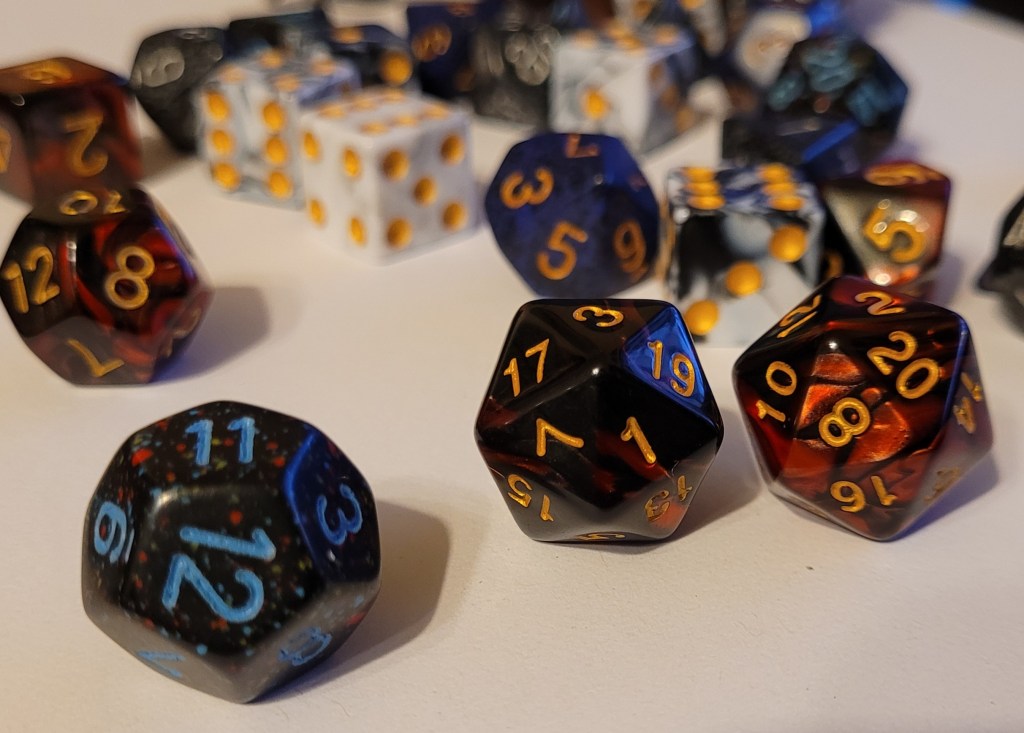
The D&D fandom at large has baggage with the term “power gaming.” Across the internet, there are thousands of posts bemoaning the practice and deterring new players from pursuing power for their character. Some go so far as to say that anyone “roll-playing” over “role-playing” are unwelcome at their tables; that having even one such guest detracts from everyone else’s fun at their table. And, more power to them. If they think people who play this way won’t gel with their game’s style, that’s a perfectly valid reason to disallow someone from joining your table. It could save a lot of headache from coming up down the road.
But the stigma is everywhere. Which is a little strange, right? After all, it’s perfectly natural to want to be strong in the fantasy game you’re playing. You’re the heroes of the adventure. Not everyone wants to be the farmer kid out of their depth. Some people want to play a veteran adventurer who knows what they’re doing. It can be a great time to be a group of bumbling fools that somehow make their way through a dragon’s lair by sheer luck, and if you’re running a less serious kind of game, that might be the perfect fit.
But if you’re running a campaign that takes itself seriously, with dangerous foes that will challenge the players’ ability to think strategically – why should they be pressured away from making powerful characters?
But this aversion didn’t come from nowhere. I’ve got some theories; I’ve done some research. Let’s sort the whole thing out.
Optimization isn’t the Problem
As far as the D&D fandom goes, there exists a clear, hard line between “min-maxxers” and “power gamers.” And, defined the way I’ve seen, I don’t disagree with the delineation. So, by and large, “min-maxxers” are players who are making the best choices they can with their character to make them as powerful as they can be, and the fandom at large doesn’t consider this a bad thing. Building to get the maximum bonus from your primary ability score early into the game isn’t something they do with their nose pinched so they don’t have to smell the stench. It’s a normal and valid thing to do.
In an ancient post on Wizards of the Coast’s forums in 2006, user Tempest Stormwind made a post to really enshrine the dissonance as fallacious, the Stormwind Fallacy (reposted here on reddit). He concluded “D&D, like it or not, has elements of both optimization AND roleplay in it. Any game that involves rules has optimization, and any role-playing game has roleplay. These are inherent to the game.” It is pointless to behave like either precludes a player from engaging in the other.
But “power gaming” has an entirely different definition: one that newer players might not realize makes it something wholly uglier and less welcome than simple min-maxxing.
Power gaming, in this context, is reserved for players that don’t just want their character to be powerful. They want their character to be the most powerful. They aren’t satisfied unless the other players’ characters are weaker than theirs. They want to frustrate the DM by killing the biggest monster in one turn and ruining the experience for everyone else. Or they want to dictate to other players what they should be doing every turn to have the greatest effect on the battlefield.
In a lot of other gaming spheres, the terms are kind of interchangeable. And carrying that learned understanding into D&D might be a deterrent for newer players, forcing them to think that making their characters strong is something to be looked down upon. Posts still crop up across the fandom to ask why “power gaming” is so hated, what’s wrong with wanting your character to be powerful? And it might be difficult for them to discover that optimizing their character isn’t the issue.
But there is another facet here that’s worth discussing.
The Arms Race
Combat in D&D can quickly become an area of the game that creates imbalance. If you have a table that’s split down the middle between min-maxxers and people casually playing the game, the optimization-focused players are likely to overshadow the casual players’ characters, intentionally or not. If these optimized characters smash through an encounter or two, the DM may scale the difficulty up to ensure that combat doesn’t become an uninteresting slog and remains challenging. The min-maxxing players have further incentive to pursue power to ensure that the challenges presented can still be overcome, and those casual players might be left even further behind.
There’s certainly something to be said for how that can completely change the dynamics of the table. It’s unfair to assume that everyone enjoys optimizing their characters, and if we want to acknowledge that optimization is a way people have fun in games, then we also need to accept that suboptimal play and casual interaction is equally valid.
How can we address that? If we’re playing a game with our friends and they interact with games in different ways, can we come to some middle ground? Is the onus entirely on the DM, or the min-maxxers? Should they tone it down? Or ask the casual player to step up?
My own table could be considered split down the middle. My current party consists of a cleric, a paladin, a barbarian, and a druid. The cleric and paladin have optimized their characters to be strong, while the barbarian is a newer player, and our druid is extremely busy with her job so she can’t put in the time to game the system as well as the others can. What did we do?
Well, we weren’t utterly hands-off when they were making characters. We helped them allocate their points for point-buy, we advise them on feats when they ask, and discussed different subclass options. They’ve built powerful characters in their own right, even if they weren’t specifically engaging with the system to do so alone.
We also approached some rigid rules with some more leniency. For instance, barbarians in 5th edition are most powerful when wielding a greataxe or other d12 weapon, and my player wanted to take the Piercer feat with its synergy for adding more dice to his crits. Rather than force him to use a lance or rapier, I allowed him to just take it with his greataxe.
I also don’t get punitive with the rules. If my players are doing something suboptimal or if they forget to mention something, I don’t hold them to their lack of word, and I’ll remind them that they have another option that they might have been meaning to think of. For instance, our Circle of Stars druid had believed that the bonus healing provided by her Chalice starry form required her bonus action, but I reminded her that it didn’t, and she could still use one during a major fight.
It’s a simple thought for me: if we’re going to have a TPK, we’re going to have one by the rules. If their character is balanced to be capable of something or intended to be able to use an ability, I’m not going to be looking for a specific set of circumstances or a forgotten word to take it away from them. If my barbarian forgets to rage on the first turn, but they still have their bonus action, I’ll let them throw it on and add that bonus damage, even if they already rolled to hit an enemy. I run tough battles, but they’re not balanced to only be hard if they’re forgetting how to play their characters.
It’s a middle ground that works perfectly for my table. All the players feel like they have an equal chance to make big swings in an encounter to affect the battlefield, and no one is left to feel like they’re underperforming. It does require a bit more creativity when it comes to encounter design: more powerful monsters, unique challenges – but I’ve been at this for over a decade and I’m not even close to being out of ideas.
There’s only one wrong way to play D&D, and that’s only if people aren’t having fun. Knowing which rules you can handwave comes with experience, but a good rule-of-thumb is to allow flavor choices through without layering a drawback on a character’s efficiency. If you want to be doing wrestling maneuvers to style your attacks while dealing your longsword damage? That’s no problem for me. Just ask your DM, and I expect they’ll say the same. I always loved it when my players were engaged enough to say more than just “I attack,” chances are they will be too.
As always, thank you for reading. Good luck out there, heroes.
 Ben Stovall Blog
Leave a comment