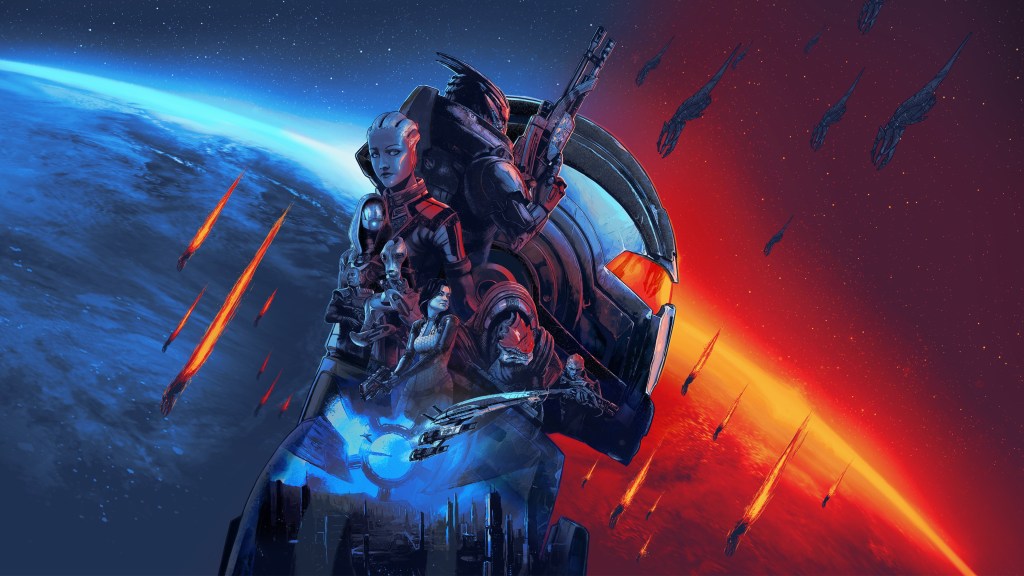
Some of the most artistically influential and significant games I’ve played in my life were developed by BioWare. I latched onto the series for much of my teenage years; I couldn’t tell you how many times I played Dragon Age: Origins throughout high school: seeing each origin, building my perfect world state to import into the sequel, finding obscure conditional options. I loved the game so much I decided to check out BioWare’s other series and got myself a copy of Mass Effect. (Spoilers follow.)
Amazingly, I latched onto it just as hard as I had Dragon Age. Harder, perhaps. I tore through Mass Effect, playing every night to explore the galaxy BioWare made. On my first run of the game I hadn’t completed Wrex’s personal quest before Virmire and failed to have the points to successfully persuade him to calm down, but I was so attached to his character that I loaded an earlier save before I’d spent my most recent level up and managed the check. It legitimately infuriated me when Ashley shot him in the back the first time. I immediately launched into New Game+ once I’d finished the campaign and went out of my way to do everything on the next run.
By the time that was all done, I learned Mass Effect 2 had been out for well over a month already and managed to pick a copy up when my birthday came around. I’d fallen in love with the first game because of its setting and narrative; Mass Effect 2 brought the game into modernity with vastly improved gameplay and ensnared me even further. I survived the so-called Suicide Mission without a single casualty on my first run. I played Overlord when it released. I blew up the Batarian Alpha Relay in Arrival and waited very impatiently for the trilogy’s end to arrive.
I took two days off of work for its release and binged through the game. I played hours of the multiplayer, beyond what was required for my Galactic Readiness to be maxed out, I felt mist in my eyes as Mordin rode the elevator on Tuchanka. I froze, wondering if I’d be able to broker a peace between the Geth and the Quarians at the end of Rannoch. The game was incredible, and I was riding high on the wave of that experience as I charged toward the beam that would let me access the citadel and use our superweapon to exterminate the Reapers and save the galaxy.
And I, like many others, felt like the ending slapped me in the face. I felt burned for being so invested in everything that had happened up to that point. Everything I’d done came down to a trinary choice that did not feel adequate in the least. I could either pursue what the villain of the first game wanted (violating every galactic citizen’s bodily autonomy in the process), pursue the Illusive Man’s goal (with an undercurrent of “this might not work forever”), or commit a genocide not just of my enemy, but also one of my allied species and sideswipe slay a member of my own damn crew. I stood there in disbelief for a handful of moments, then grimaced as I did what I’d been sent there to do: Destroy the Reapers.
I found I was not alone in my upset. I scrolled through dozens of threads on Reddit in the following days. Criticism was not hard to find. Theories decrying the ending as a hallucination felt more acceptable than what had been served. I returned to replay the final moments when BioWare released their Extended Cut of the ending, and still left dissatisfied. So badly had I felt burned by the ending that I did not buy any DLC for Mass Effect 3 or play the campaign again. (That multiplayer rocked though, I played it a few more times.)
This year, I purchased the Legendary Edition during the steam sale for $15, which combines the trilogy into a single platform with updated graphics (and gameplay for the original). I hadn’t played these games in over a decade (I’d originally owned them on an Xbox 360 and hadn’t repurchased them on PC at any point, so I hadn’t even had the ability for perhaps six years).
For a few weeks during the summer, I was consumed by them once again. Every evening when I got off work, I launched into Mass Effect. These games were just as incredible now as they were before, but all the while, I wondered if the other shoe would land as harshly as it had before. I reached the third game and reveled in how unbelievably well they managed to make it, dreading the moment I would reach the end and wondering if I would be angry about it all over again.
It was near the end of the game that I played Mass Effect 3’s DLCs for the first time. I retook Omega just before Priority: Thessia, I discovered the truth of the Leviathan just before exposing Sanctuary and Cerberus’s activities there, and completed the Citadel just before launching the assault on the Illusive Man’s base. After these missions, when I finally reached the end of the game, I discovered that my anger about the ending had materially changed.
In 2012, when I spoke to the Catalyst and was given my three decisions for how to irrevocably change the galaxy, I hated its existence as a writing device. It felt like the voice of the author had come down to tell me how it ended, and I couldn’t have been more frustrated. Now, in 2023, after Leviathan and the Citadel, I only disliked the personified Catalyst as a character. I thought it to be fallible now, and not a voice of omnipotent knowledge. I knew now that it had been created by the race that it turned into the Reapers and it had a flawed understanding of the galaxy. It thought war between organic and synthetic life was an irrefutable fact, when I had already brokered peace between the Geth and Quarians and they were working together to resettle Rannoch. I had seen an AI and a human man fall in love with one another. I knew it was just a dumb machine rather than an authority, and I blew the Reapers to hell once again.
The Catalyst didn’t know the galaxy half as well as it thought it did. For it, the status quo of galactic extinction every 50,000 years was an acceptable outcome. Whatever it thinks isn’t worth a damn. It’s probably wrong about the Geth and EDI being destroyed anyway, or it’s lying because it wants to save its toys.
These games were some of the most influential and significant games of my life. It’s incredible to have found a way to enjoy and love them again, whether my interpretation of the ending is supported by canon or not. As always, thank you for reading. I should go.
 Ben Stovall Blog
Leave a comment